
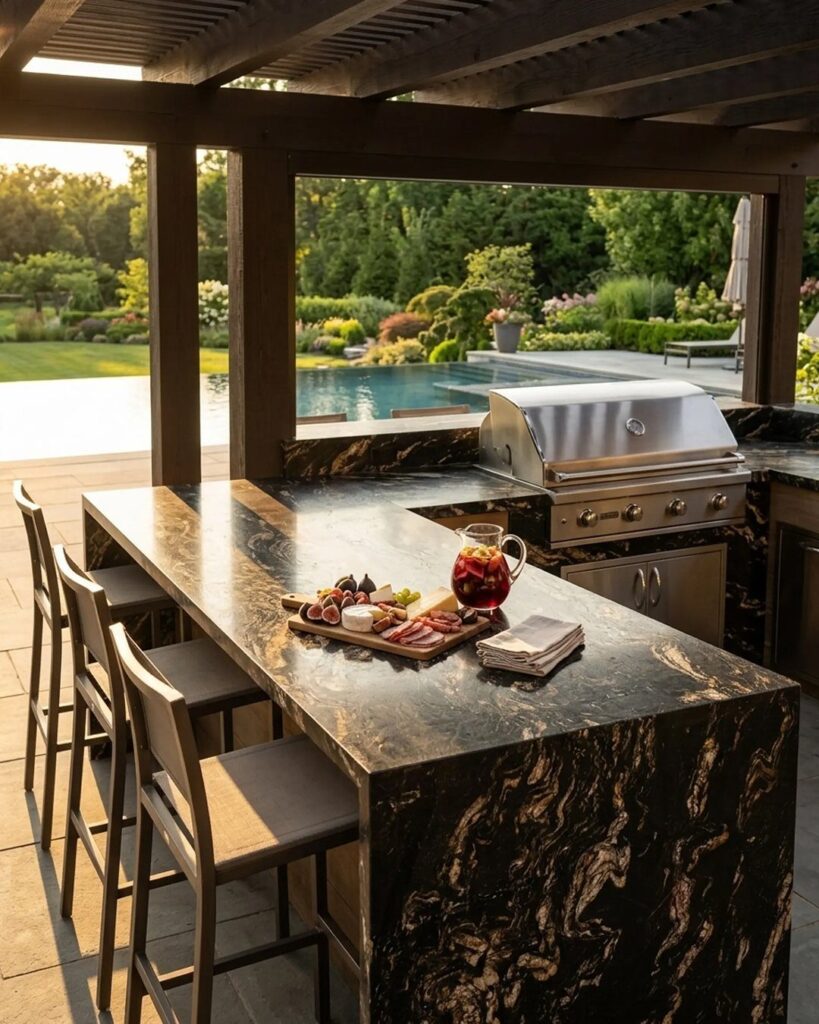
A basic outdoor countertop install starts around $50 per square foot; once you add cutouts for grills, curved edges, or a built-in sink, you are looking at $200 or more.
What actually matters is how the material holds up outside: granite and quartzite handle freeze-thaw cycles that crack standard concrete, tile grout lines need resealing against stains from raw meat and spilled wine, and wood demands regular oiling or it warps and hosts bacteria in the grain.
1. Granite Countertops
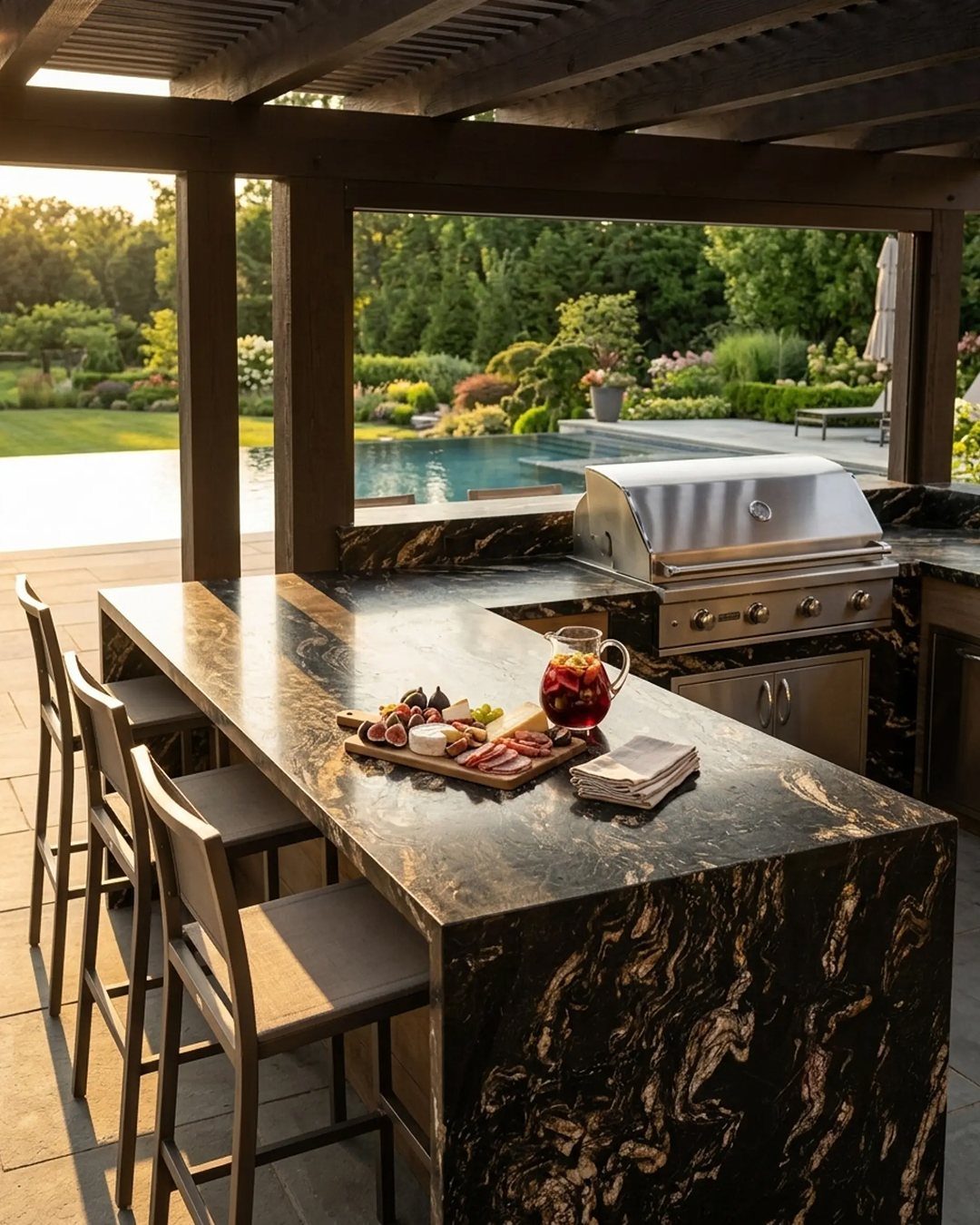
Black-and-gold veined granite handles heat from a grill or a pizza stone without flinching, and that polished face stays flat through years of outdoor seasons.
I like it best under a covered patio where the sealer gets a break from direct sun; keeping up with resealing keeps the gold veining sharp against the dark ground.
For a poolside setup like this, the waterfall edge is worth the extra fabrication; the stone looks thick even at a slim profile, though it does eat into your knee room since the slab runs straight to the ground.
Budget runs higher for the exotic veining, so get a few quotes before you settle on a slab.
2. Concrete Countertops
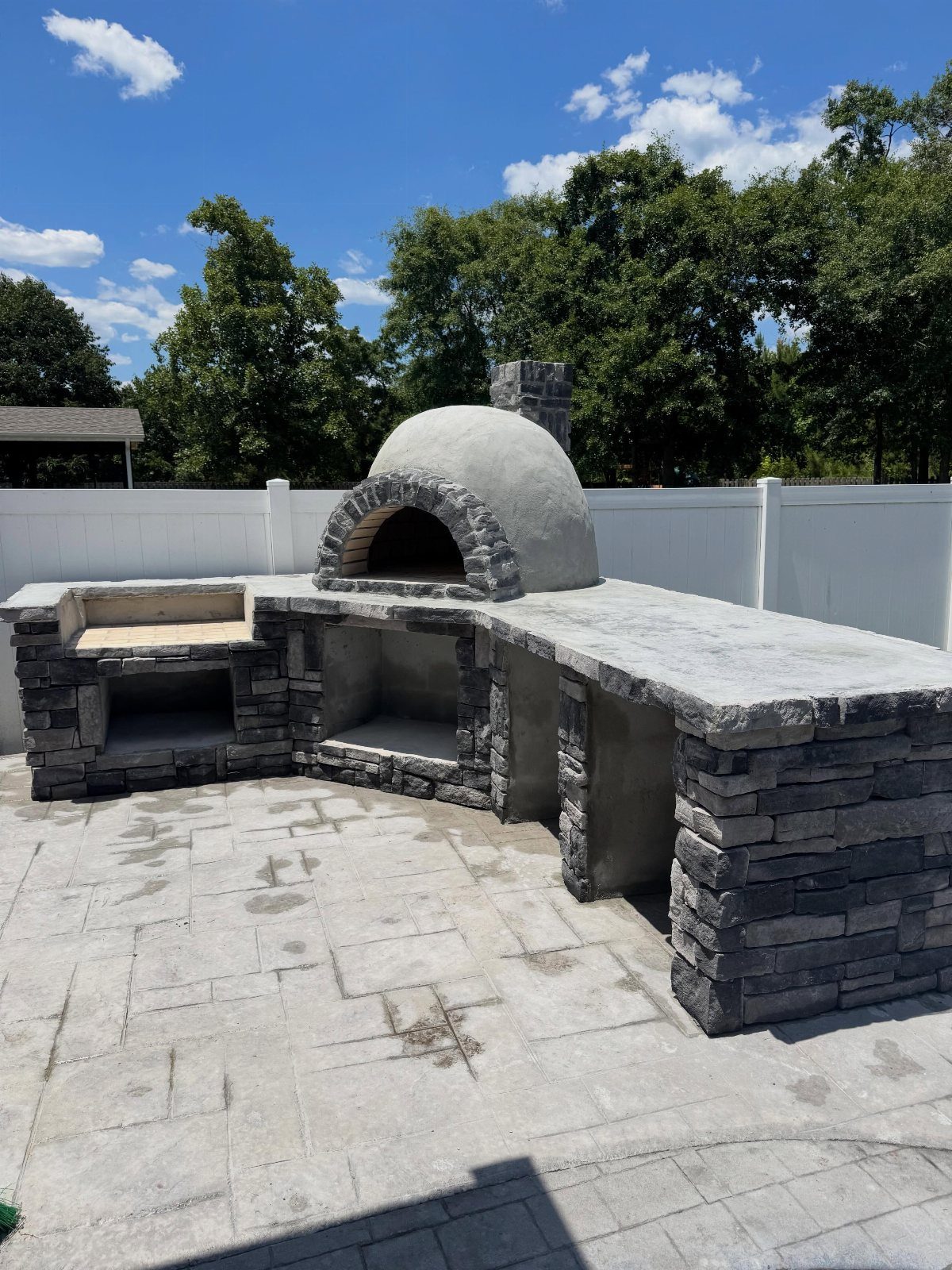
Poured concrete lets you shape the counter to fit a domed oven or an irregular patio corner, and the surface takes pigment or a acid stain to match the stone base.
I would form it with integral sinks or drainboards if you wash produce outside; the mix needs air-entrainment for freeze-thaw cycles, especially in Indiana winters.
Expect hairline cracks, they are part of the material’s character and usually stay tight if the steel reinforcement is placed mid-slab.
A thick pour with mesh runs more than broomed concrete, and a polished cream finish pushes the price up again.
3. Quartzite Countertops
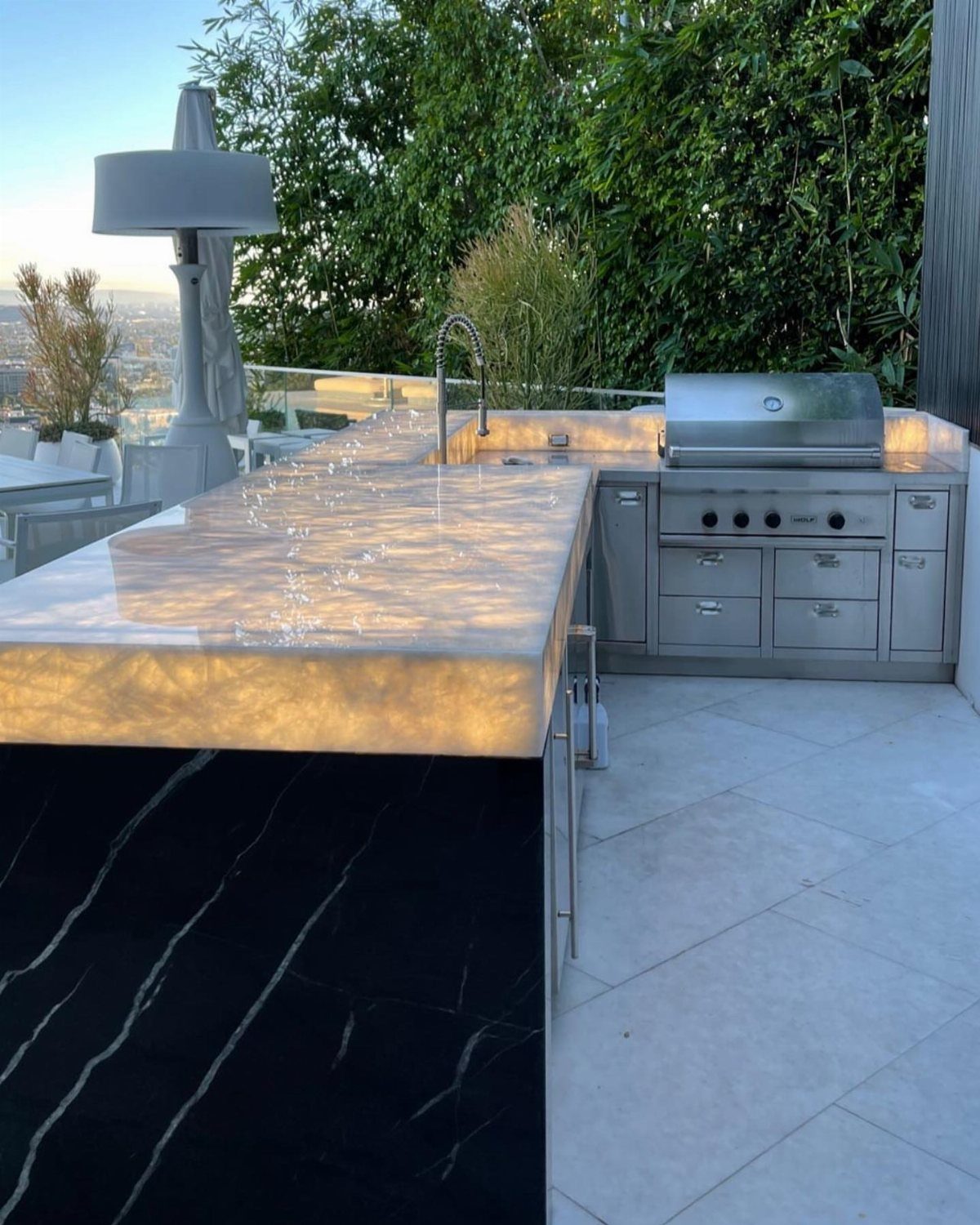
Backlit quartzite gives you the cool look of marble with a Mohs hardness closer to granite, so knife slips and dragged pots do less damage.
I would seal it twice before the first use; the resin fillers in some slabs can yellow under UV if the supplier used a lower-grade epoxy.
The subtle veining here reads as calm rather than busy, which suits a city-view kitchen where the landscape already competes for attention.
For outdoor use, stick to lighter tones; dark quartzite can get dangerously hot in direct July sun and stay that way past cocktail hour.
4. Wood Countertops
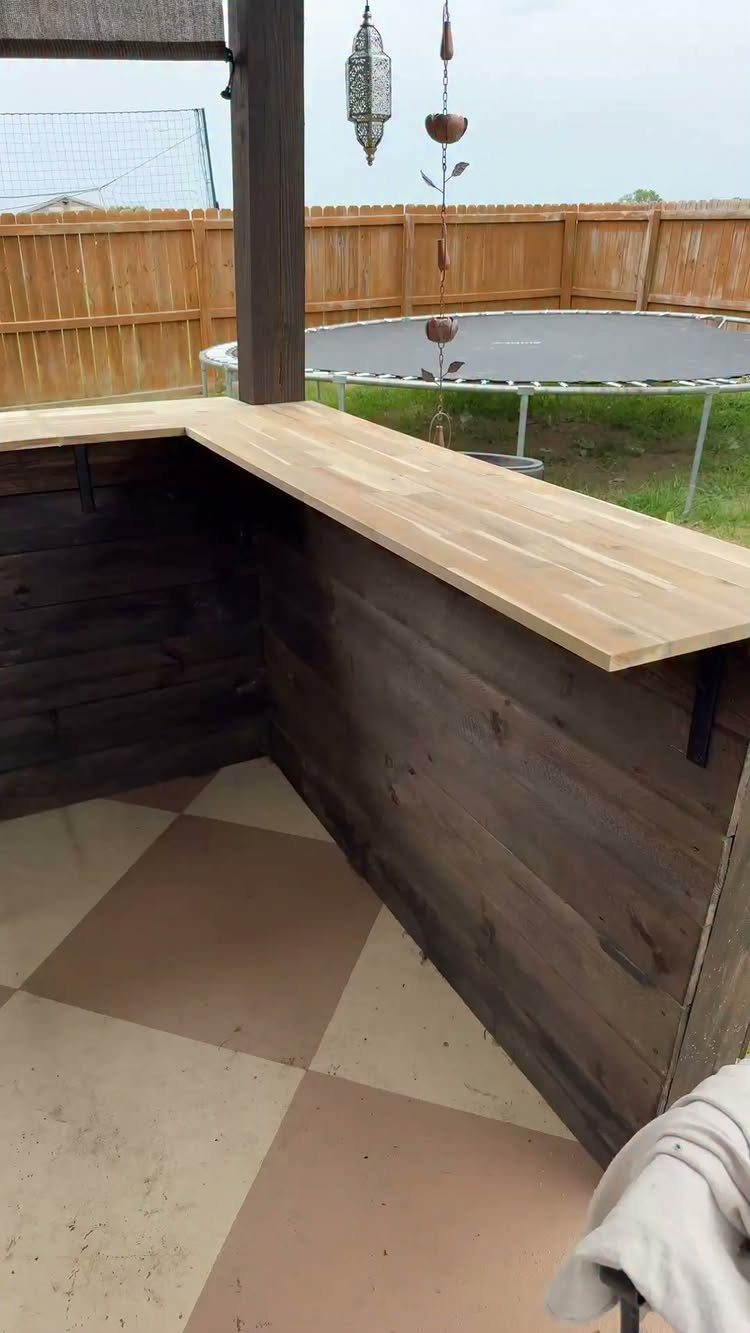
Light wood on a dark frame warms up a backyard bar the way stone or concrete never quite does, and an L-shape gives you serving space on one leg and prep on the other.
I would use white oak or black locust for outdoor duty; they move less than maple and take a penetrating oil better than a film finish that will peel.
Re-oil twice the first season, then once each spring; the graying starts where water pools, so pitch the surface slightly toward the yard. Among natural options, this is the cheapest, and the character builds fast.
5. Outdoor Oiled Butcher Block
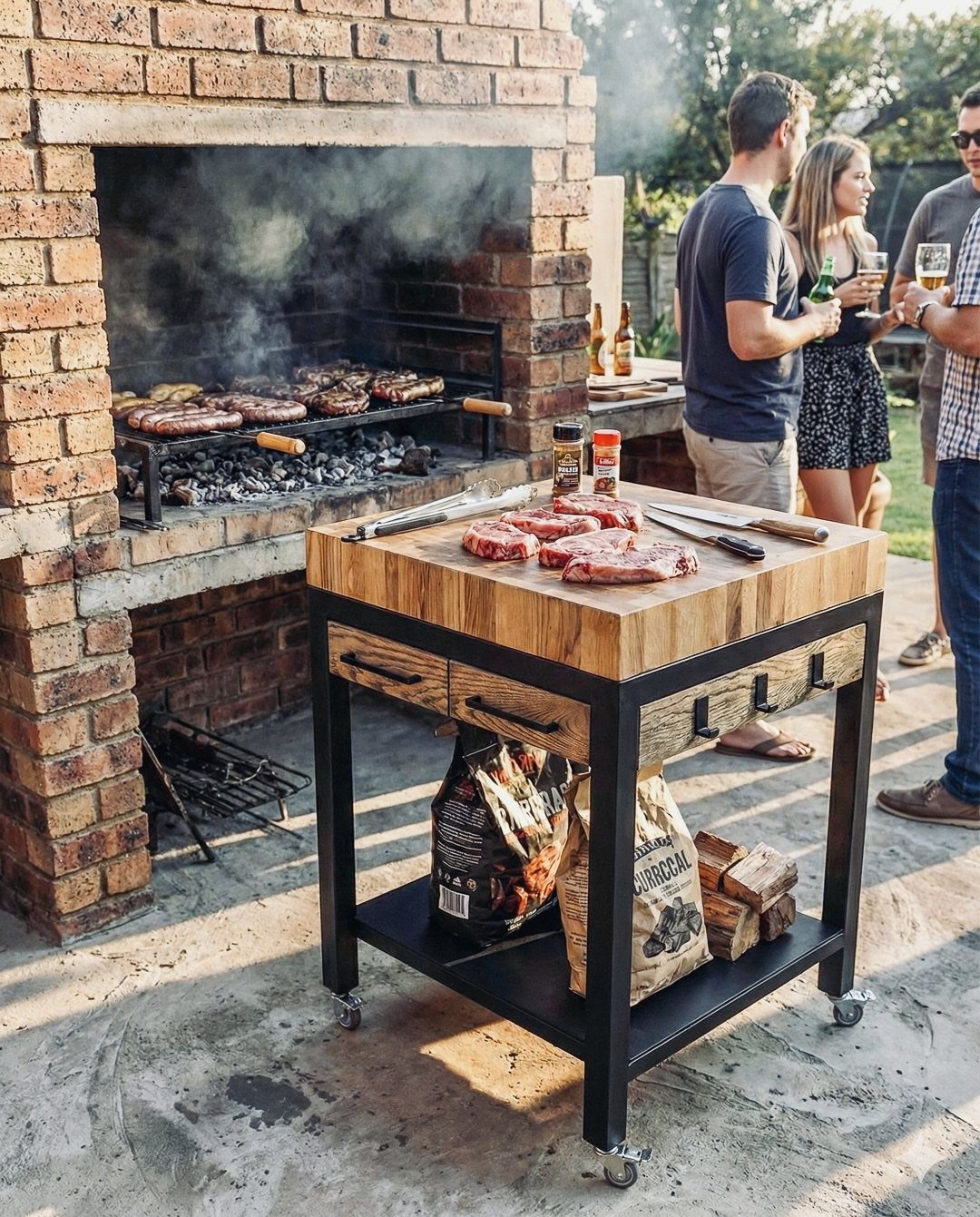
A thick butcher block on a rolling cart moves where the grill is hot or the shade has shifted, and the end-grain surface is kinder to knife edges than any stone.
I would keep the oil fresh; raw meat juice plus sun-dried wood is how bacteria get comfortable, and a food-grade mineral oil with beeswax resists washing out better than plain oil.
The black metal frame here is powder-coated steel, which I would swap for aluminum if you live near salt water.
For a cart you build yourself, hard maple end-grain runs a few dollars per board foot, and you will want casters rated for serious weight.
6. Patterned Ceramic Tile Countertop
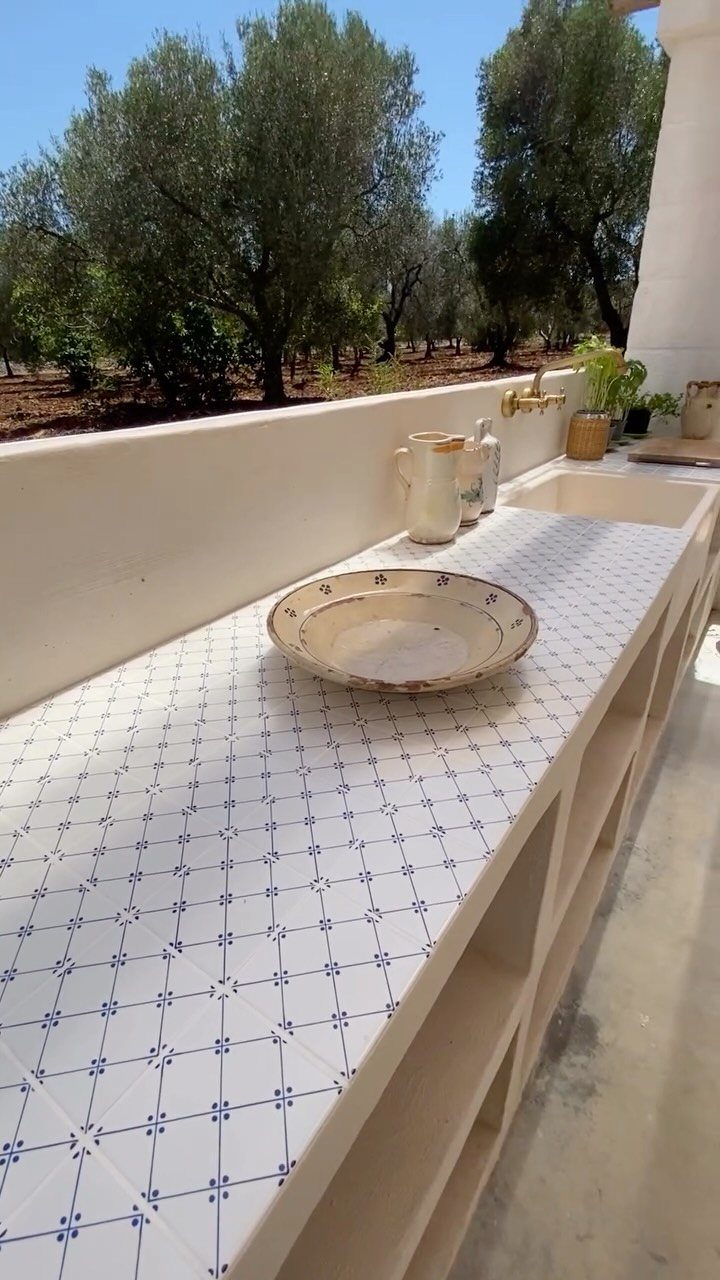
White field tile with a blue pattern gives you a surface that stays cool to the touch even in August, and the grout lines add grip for wet glassware.
I would use a porcelain body rather than earthenware; the lower absorption rate matters when rain hits a counter with open shelving below and nowhere for water to hide.
The tile and setting run a moderate price per square foot, plus the cost of a brass faucet that will patina rather than rust.
7. Textured Stone Slab Countertops
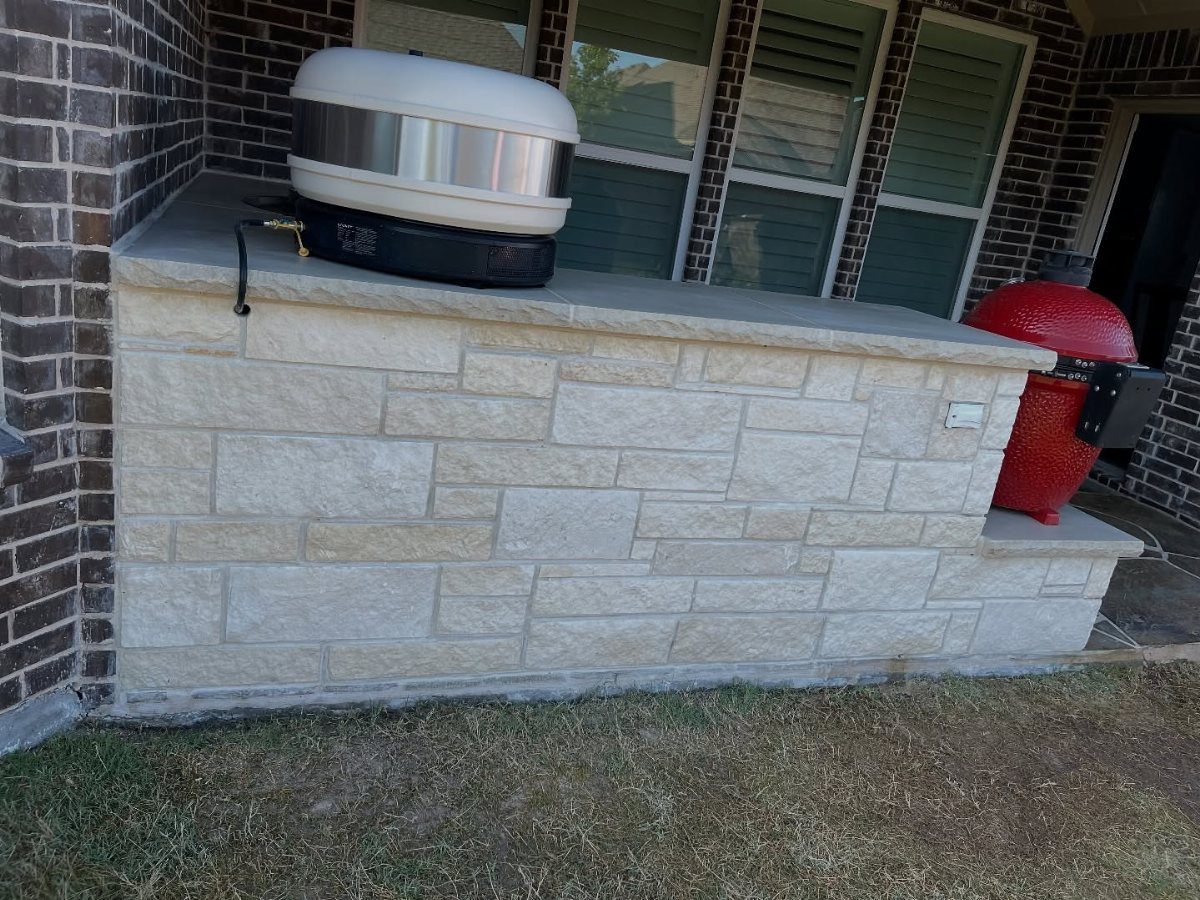
Rough-faced limestone or sandstone veneer carries the wall’s texture right across the counter, so the kitchen reads as built from the patio up rather than dropped onto it.
I would set the slab with a slight overhang for knee room; the irregular face catches drips and splatter less than a polished top, and the shadow lines hide the dust that shows on dark granite by Wednesday.
The stone runs cooler than concrete in direct sun, and the lower ledge for the grill keeps the cooking heat away from your prep surface.
Budget sits mid-range between poured concrete and exotic granite, and a local stone yard often has remnants wide enough for a single grill run.
Maintenance Requirements
Annual sealing is the baseline for most outdoor stone, and I would not skip it even in a mild year.
A pH-neutral cleanser is the right choice for regular washing; acidic or alkaline products strip sealer faster and open pores that bacteria then colonize.
A covered structure is not required, but it cuts UV exposure and rain load enough that I would build one before I spent money on exotic veining that will fade anyway.
Concrete with air-entrainment still needs its sealer refreshed, though hairline cracks are not a maintenance issue if the steel was placed properly.
Wood and butcher block are the outliers here, needing oil instead of sealant, and more often at first, twice a season until the grain is saturated.
Key Factors in Choosing Countertops
Sunlight is the factor most people underestimate.
UV degrades resin fillers in quartzite, yellows lower-grade epoxies, and will fade anything with organic pigment; I would place any light-sensitive material where a roof or wall gives shade for part of the day.
Moisture and temperature swing together: water enters at the warm point, freezes at the cold point, and the expansion cracks stone or concrete that was not formulated for it.
Air-entrainment in concrete addresses this directly; for stone, the sealer is your only defense.
Bacteria resistance matters most on surfaces that will see raw meat, which makes nonporous finished stone or properly oiled wood preferable to raw concrete or tile with wide grout lines.
Maintenance load should match your actual schedule, not your aspirations; oiling wood twice a season is realistic for most people, annual sealing is achievable, monthly fussing is not.
Aesthetics are personal, but I would let durability narrow the field first, then choose color and texture from what remains.
Cost Considerations
Installed outdoor countertops run from $50 to $200 per square foot, and the spread comes from material choice plus fabrication complexity.
A simple rectangular slab in mid-range granite or concrete sits at the lower end; a waterfall edge, integral sink, or custom shape pushes any material toward the top.
The cost of installing a stainless steel outdoor countertop varies, with the metal grade and gauge chosen for the project being significant factors. On average, the cost of materials and installation for a stainless steel outdoor countertop ranges from $100 to $200 per square foot.
— Angi
Frequently Asked Questions
What type of countertop can be outside?
Granite, concrete, quartzite, wood, butcher block, ceramic tile, and textured stone like limestone or sandstone all work outside if you choose and maintain them right.
Stone, concrete, and wood all survive outside but ask different things of you: annual sealing for stone, air-entrainment in the concrete mix so freeze-thaw does not crack it, and oil rather than sealant for wood.
I would match the material to your climate and how much cover it gets, since UV and moisture together do the most damage.
Is it better to have an outdoor kitchen covered or uncovered?
Covered is better for the countertop’s lifespan, though not required. A roof or partial wall does enough against UV and rain that I would put money there before paying for dramatic veining that will bleach out regardless.
Uncovered is doable if you keep up with sealing and accept the heavier maintenance schedule; even properly air-entrained concrete wants its sealer refreshed on time.





