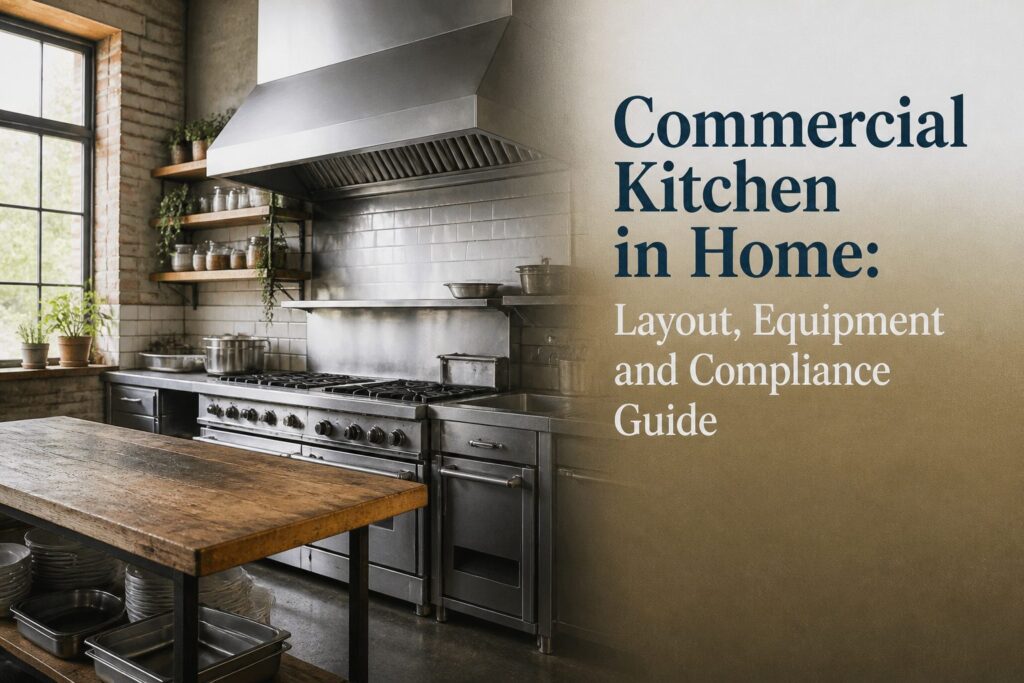
A commercial kitchen in home is a professional-grade food production space built inside a residential property, subject to health department inspections, fire codes, and ventilation standards that ordinary home cooking never triggers.
The conversion only works legally once you replace residential wiring, gas lines, and flooring with infrastructure sized for continuous industrial use.
Most operators underestimate the hood: a Type I exhaust with exterior ducting and make-up air, because grease-laden vapors will destroy standard residential ductwork.
What a Commercial Kitchen Is
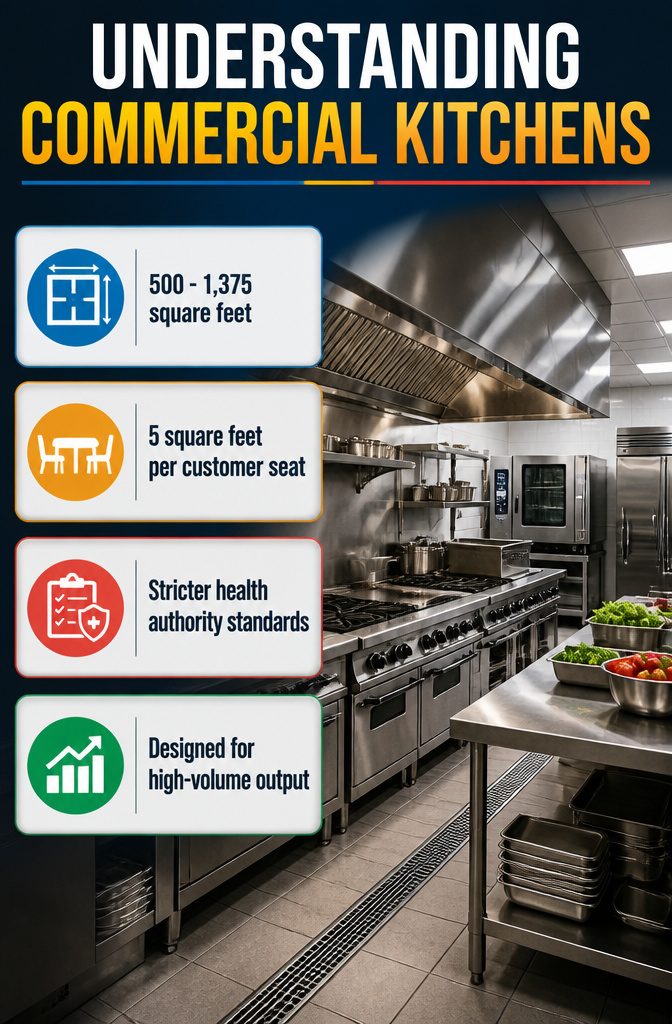
A commercial kitchen is a professional-grade space built for high-volume food production, outfitted with industrial-grade stoves, ovens, and refrigeration units that can run continuously through peak service.
Unlike the kitchen in your home, where the priorities are comfort and flexibility for a few meals a day, a commercial layout is designed around output volume, speed, and the safety regulations that govern both.
The size gap is substantial.
Most commercial kitchens fall between 500 and 1,375 square feet, with the industry average sitting near 1,000 square feet. A useful rule of thumb is 5 square feet of kitchen space per customer seat you plan to serve.
That ratio is worth keeping in mind if you are converting part of a home toward any commercial use; it scales the footprint to actual demand rather than guesswork.
Home kitchens are subject to basic cleanliness expectations. Commercial kitchens face stringent health authority standards for food handling, storage, and sanitation, plus regular inspections.
The layout reflects this: dedicated zones for prep, cooking, cold storage, and dishwashing, each sized for headcount and equipment, with workflow mapped to eliminate bottlenecks during rushes.
A residential kitchen, by contrast, is typically compact and multipurpose, optimized for a small household rather than throughput.

【Stainless Steel Range Hood】Our kitchen hood is made of 430 grade stainless steel with brushed finish, simple, classic, and easy to clean. It is equipped with a built-in bright energy-saving LED light to evenly illuminate your cooking area,allowing you to clearly see while cooking.

【Under Cabinet Range Hood with Slim Design】With the slim and stainless steel body, this range hood 30 inch under cabinet is space-saving and easy to install. The rocker button can control 2-speed wind speed and LED lighting, which is easy to operate. Product Size: 29.9 inch x 17.5 inch x 4.7 inch( L x W x H). (Hardwire installation, plug sold seperately Part#ZMS-3976-PC)
Types of Commercial Kitchens
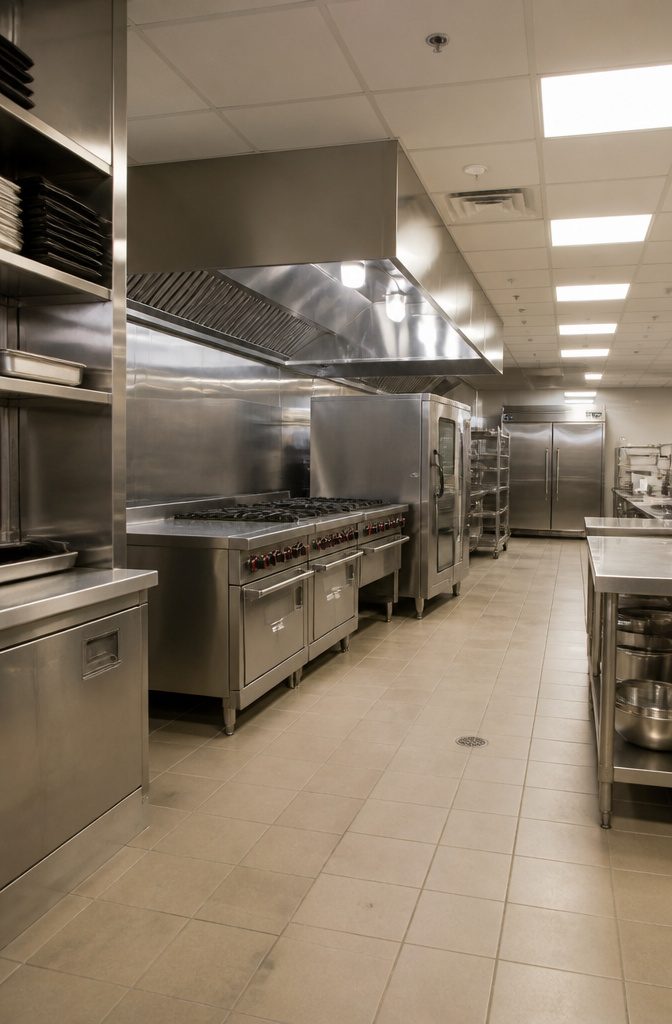
Commercial kitchens sort into four workable types, each built around who the food actually reaches.
Restaurant kitchens run the hardware you picture: heavy-duty convection ovens, commercial ranges, high-output fryers, the full line.
The layout moves from raw intake through prep, cooking, and out to the pass in a straight flow, because every minute of ticket time matters when diners wait in the next room.
Hotel kitchens layer on volume and hour flexibility, often feeding a restaurant, room service, and banquet halls from the same footprint.
The equipment scales up accordingly, and the storage does too: walk-in coolers, deep freezers, dry shelving stacked for bulk rotation.
Catering kitchens break from that model because the food travels.
The design prioritizes holding equipment and transport logistics over the immediacy of plate-to-table. You see dedicated staging zones, wider aisles for rack movement, and packaging infrastructure built into the workflow rather than bolted on at the end.
Cloud kitchens, also called ghost kitchens, strip away everything except the line itself.
No dining room, no pass, no front door. The space is optimized for speed in prep and packaging alone, with equipment selected to manage orders from multiple delivery platforms at once.
These are delivery-only operations and a cost-effective expansion path for brands that never intend to seat a guest. The investment goes into output volume and platform integration, not into atmosphere or service flow the customer will never see.
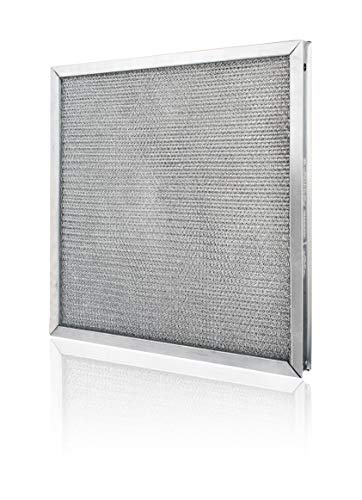
Aluminum frame and media effectively captures dirt and dust particles from the air stream for commercial kitchen supply fans, heaters, and make up air units.

Art of Air Cosmetic Makeup Airbrush and Compressor System
Aluminum frame and media effectively captures dirt and dust particles from the air stream for commercial kitchen supply fans, heaters, and make up air units.
Designing the Layout
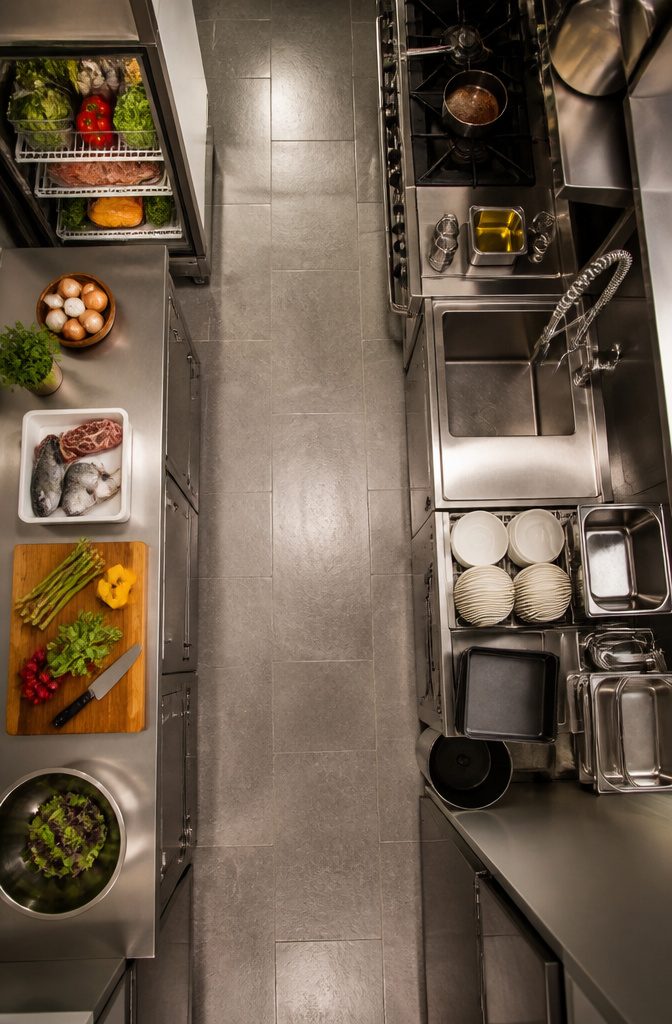
Efficient workflow in a commercial kitchen in home starts with aisle width.
3 feet is the functional minimum, though I push toward 5 feet where the floor plan allows; the extra space lets two people pass with a tray or a hot pot without the shuffle that slows everything down.
Narrower than 3 feet and you are planting frustration.
I favor separating the room into three anchored zones: preparation, cooking, and cleaning. Prep sits closest to the cold storage so proteins and produce move straight to the board.
The cooking bank lives in the center, with the cleaning station downstream and the dish storage directly above it. That sequence, left to right or right to left, is the assembly line layout.
It works when you are plating multiple meals in sequence, one dish after another moving in a straight line. High-volume cooks, the ones running catering prep out of a garage or baking for Saturday markets, usually choose it.
The zoning layout clusters equipment by task instead of sequence. A bakery setup might keep three ovens, a proofer, and a cooling rack in one quadrant while the savory work happens across the room.
If your commercial kitchen in home serves more than one purpose, zoning saves you from crossing the room with a sheet tray every five minutes. The assembly line is faster for single-focus work; zoning is calmer when the menu splits.

Durable Construction: Our shelving unit is made with high-quality galvanized green epoxy resin, ensuring long-lasting durability and resistance to rust and corrosion in both dry and moist environments.

Only for pick up in our nearest warehouse at present, pls contact us first. DIMENSIONS: Walk-in refrigerator unit measures 6 ft wide, 10 ft deep, and 8 ft tall, providing ample cold storage space.

Choosing Equipment
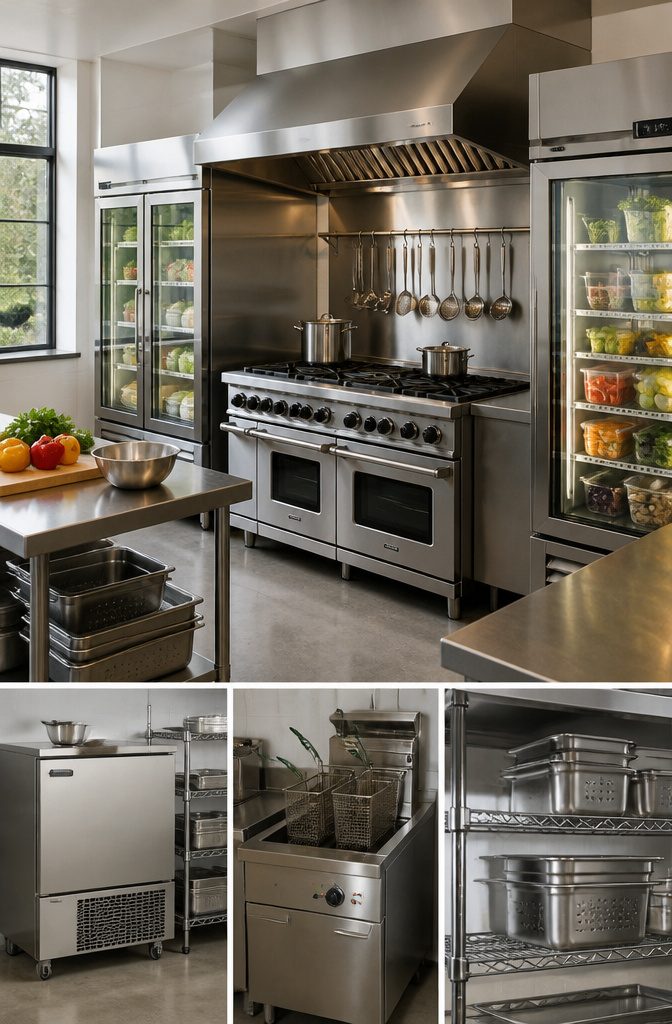
Every piece of cooking equipment in a commercial kitchen answers back to your menu and your volume.
A home stove rated for a family of four will not survive fifty covers a night, and the cost of a breakdown mid-service is higher than the upfront price of a range built for that load.
I start with the cooking core: stoves, ovens, grills, fryers, steamers, and the specialty units like blast chillers that some menus demand.
If your production stays under twenty meals an hour, a heavy-duty residential range with a commercial hood might carry you. Past that point, gas or electric commercial ranges with greater BTU output and oven capacity are the only sensible path.
Refrigeration follows the same sizing logic.
A reach-in freezer and a walk-in refrigerator each serve a different scale. The walk-in wins when you are receiving case lots and holding prep for multiple days; the reach-in suits tighter spaces and lower throughput.
Neither can be guesswork. Food storage then keeps that refrigerated flow organized: stainless steel shelving for dry goods and smallware, wire racks for sheet pans and cutting boards.
The wire rack lets air move around trays, which matters for cooling baked goods and for holding temperatures in a busy line.
Dishwashing closes the loop, and here the commercial machine diverges sharply from what home cooks expect.
A true commercial dishwasher strips out every convenience feature. There is no adjustable racking, no garbage disposal, no quiet cycle.
It washes and it sanitizes, and the dishes must be thoroughly rinsed before they go in. For a lower-volume operation, some operators choose the triple sink for manual washing and sanitize in place of the machine.
The three-compartment setup takes more labor but fewer dollars upfront and less square footage. The commercial dishwasher only pays for itself when throughput justifies the speed and the staff cost it replaces.

【85° FOLDING SLIDING FOR EFFORTLESS OPERATION】Push-pull folding design allows adjusting to any angle up to 85°. Smooth sliding tracks ensure one-person easy opening/closing, efficient for food serving or item passing.
【85° FOLDING SLIDING FOR EFFORTLESS OPERATION】Push-pull folding design allows adjusting to any angle up to 85°. Smooth sliding tracks ensure one-person easy opening/closing, efficient for food serving or item passing.
【85° FOLDING SLIDING FOR EFFORTLESS OPERATION】Push-pull folding design allows adjusting to any angle up to 85°. Smooth sliding tracks ensure one-person easy opening/closing, efficient for food serving or item passing.
Ensuring Regulatory Compliance
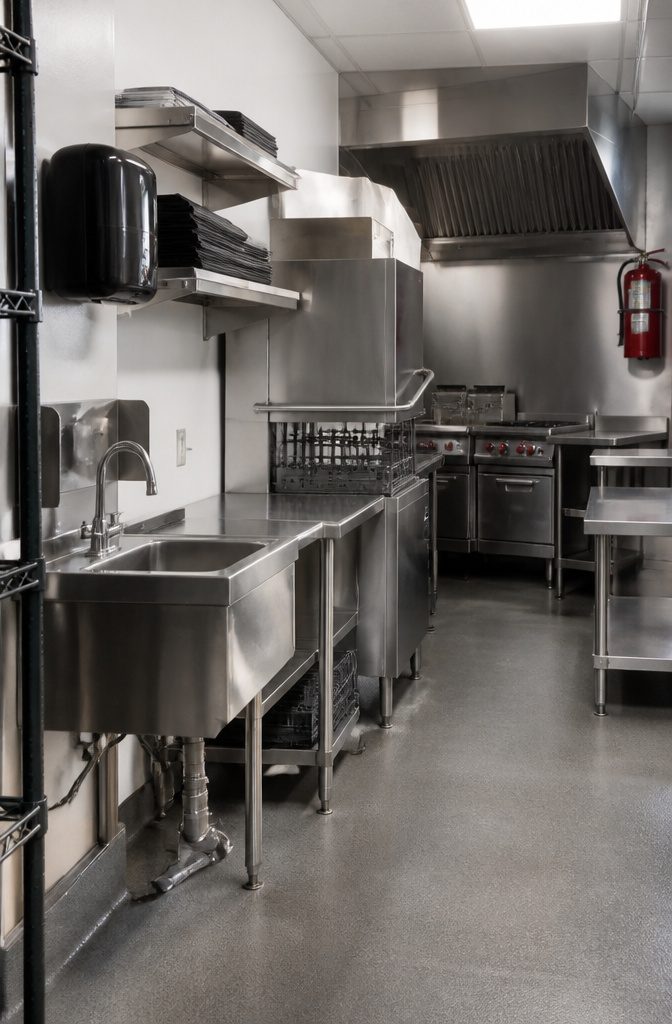
A commercial kitchen in home only becomes legally operable once it meets the exact standards your local health department and fire marshal enforce.
Those standards cover four areas most home cooks never think about: food safety protocols, fire suppression systems, mechanical ventilation, and scheduled inspection cycles. Compliance is not a finish-line you cross once; it is a condition you maintain.
I have watched operators assume their residential setup passes muster because it looks professional, only to learn that the hood needs separatemake-up air and the floors require coved bases at every wall joint.
Food safety starts with handwashing stations installed independently of any sink used for dishwashing or food prep.
Temperature monitoring for refrigeration and hot-holding equipment must be logged, not eyeballed. Fire codes typically demand a Class K extinguisher within 30 feet of any cooking surface, plus an automatic suppression system tied to the hood.
Ventilation requirements are where most home conversions fail: commercial cooking generates grease-laden vapors that residential ductwork cannot handle, so you will need a Type I hood with proper fan capacity and duct routed to the exterior, never into an attic or chase.
Inspection protocols run on fixed schedules, often quarterly or semiannual, and the inspector has authority to shut you down on the spot.
The rules shift by county and sometimes by city, so the only safe move is to pull your jurisdiction’s current code before you buy a single piece of equipment.

LOW TEMP DISH MACHINE SANITIZER - Liquid chlorine sanitizer for dishes, glasses and utensils in low-temperature commercial dish machines. Also works in high-temp machines. Feed into the final rinse.

Upgrade to Superior Training-Enhanced Labels: Create proper dishwashing procedures with step-by-step guidance, a level beyond ordinary labels.

1 BOTTLE OF STERAMINE SANITIZING TABLETS FOR COMMERCIAL AND PROFESSIONAL USE – This bottle contains 150 concentrated Steramine sanitizing tablets, delivering a powerful and effective solution for maintaining hygiene in restaurants, bars, commercial kitchens, and food prep areas. Perfect for sanitizing utensils, food contact surfaces, kitchen equipment, and high-touch areas, these tablets help ensure compliance with health department regulations and promote a clean, safe environment. Ideal for use in catering services, healthcare facilities, and other high-traffic settings, Steramine provides dependable, easy-to-use sanitation for a wide range of professional cleaning needs.
Integrating Technology
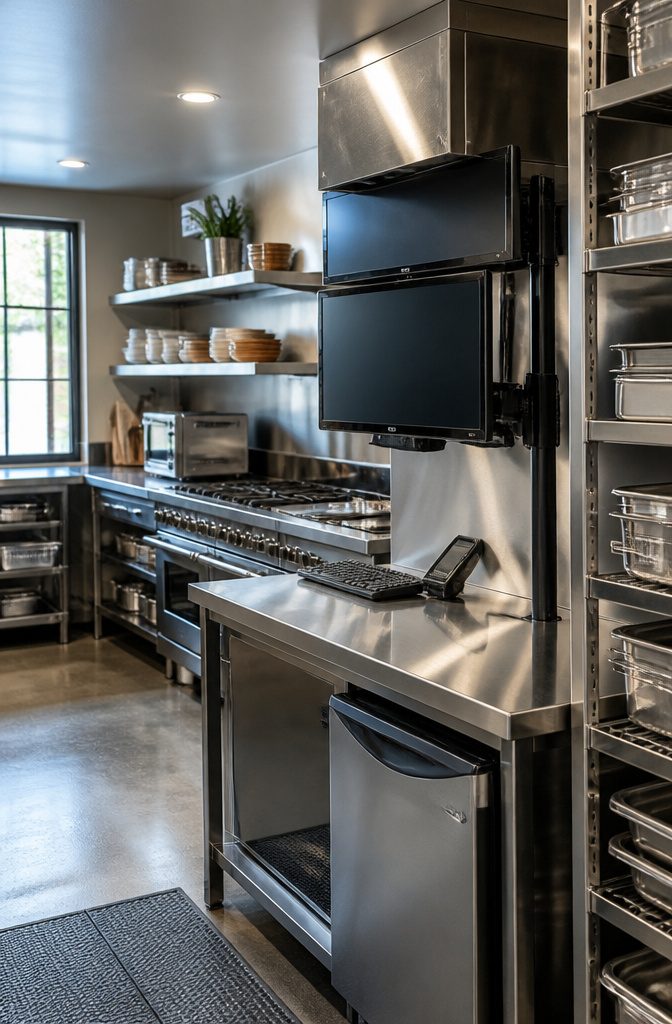
Kitchen display systems fed by a point-of-sale terminal eliminate the paper ticket stack that piles up during service.
I watched this transition in a friend’s compact operation, and the immediate change was the drop in wrong orders, since every modification prints in the same place the cook reads it, not whispered across a counter or rewritten on a scrap.
Inventory management software linked to those tickets lets you see what moves and what sits before you reorder.
For a home-based kitchen operating under cottage-food or commercial permits, that visibility matters more than in a large kitchen because one bad buy ties up the whole budget.
Temperature monitoring with digital logging does the compliance documentation for you; health inspectors in most jurisdictions accept those logs, and the sensor pays for itself the first time it catches a cooler cycling warm overnight.
Order management platforms that tie front and back together keep the person baking from having to answer the phone or check an email account between trays.
In a residential space where one door serves both home and business, that coordination is what keeps a dinner service from colliding with family life.

【Powerful 400 CFM Suction】This 30-inch under cabinet range hood delivers a robust 400 CFM airflow, effectively capturing smoke, grease, and cooking odors to keep your kitchen fresh. Hard-wired installation (plug not included) for a clean.

900 CFM DUAL-MOTOR POWER: Powerful dual motors deliver up to 900 CFM airflow for demanding everyday cooking, helping clear heavy smoke and odors from frying, searing and high-heat cooking more efficiently.

POWERFUL YET QUIET: Enjoy strong extraction performance that quickly clears cooking fumes and steam. Despite its powerful airflow, this stainless steel kitchen vent hood operates quietly, allowing you to cook, converse, and entertain without excessive noise.
Planning for Scalability
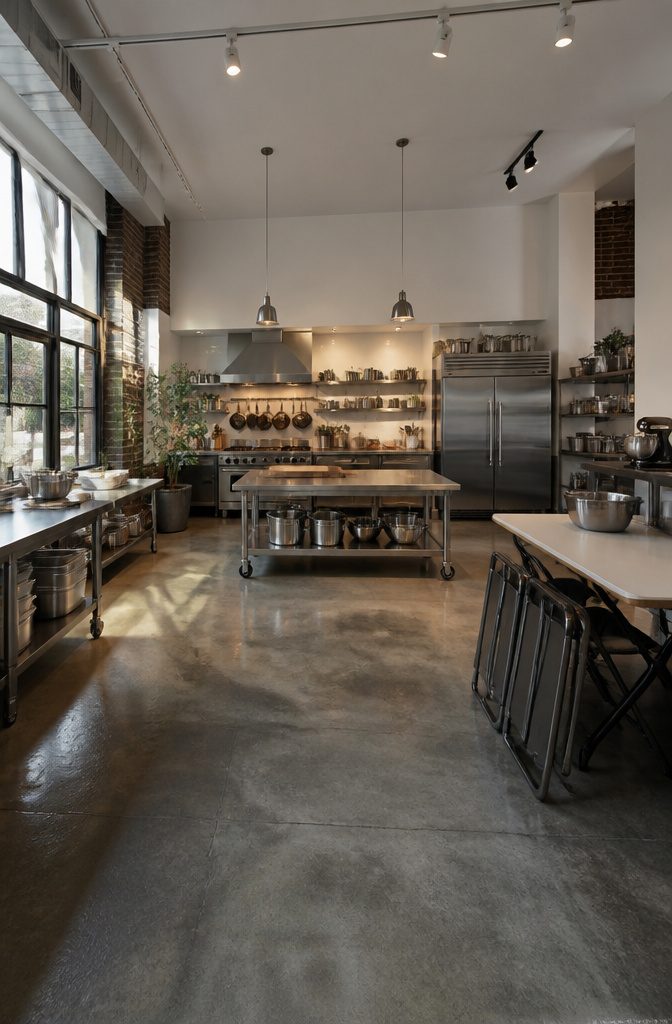
A modular workstation arrangement separates the kitchen that grows from the one that stalls. I start every layout assuming the volume will double, because in a home commercial kitchen that jump usually arrives faster than expected.
Fixed equipment against load-bearing walls locks you into today’s menu; equipment on casters, with quick-connect gas and electrical hookups, lets a baker become a caterer without tearing out drywall.
Expandable prep space matters exactly as much. A folding wall or a secondary island on locking casters turns a one-person morning into a three-person afternoon, then folds back so the room still functions for dinner service.
I have watched cooks lose entire seasons because their "temporary" jam session became permanent and they had nowhere to stage the next product line.
Infrastructure is where professional planning pays for itself. Sizing the hood, the grease trap, and the electrical panel for 150 percent of current draw costs more upfront, but a full renovation mid-growth costs ten times that.
A makeshift setup patches around limits; a scalable kitchen identifies the likely bottleneck and builds past it from day one.
Aluminum frame and media effectively captures dirt and dust particles from the air stream for commercial kitchen supply fans, heaters, and make up air units.

Belloccio’s exclusive airbrush foundation will change your makeup application forever!
Aluminum frame and media effectively captures dirt and dust particles from the air stream for commercial kitchen supply fans, heaters, and make up air units.
Commercial Against Residential Kitchens
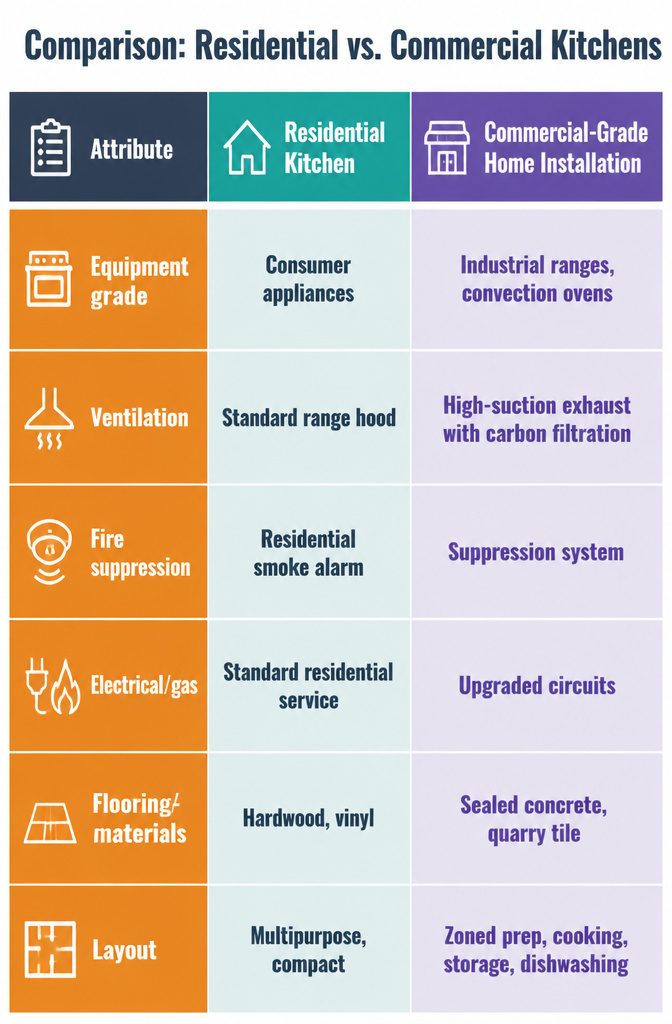
A commercial kitchen built into a home inherits equipment and infrastructure standards that residential wiring, gas lines, and flooring were never sized for.
Industrial-grade stoves and convection ovens pull more current than standard 240-volt circuits allow; commercial ventilation must exhaust grease-laden air at rates residential range hoods cannot move.
The floors that survive daily service traffic are sealed concrete or quarry tile, not the vinyl or hardwood common in homes.
| Attribute | Residential Kitchen | Commercial-Grade Home Installation |
|---|---|---|
| Equipment grade | Consumer appliances | Industrial ranges, convection ovens, high-output fryers |
| Ventilation | Standard range hood | High-suction exhaust with carbon filtration |
| Fire suppression | Residential smoke alarm | Suppression system (building code varies by jurisdiction) |
| Electrical/gas | Standard residential service | Upgraded circuits; natural gas or propane lines sized for continuous load |
| Flooring/materials | Hardwood, vinyl, tile | Sealed concrete, quarry tile, stainless steel surfaces |
| Layout | Multipurpose, compact | Zoned prep, cooking, storage, dishwashing |
The cost gap is not just the equipment itself. Walk-in coolers, integrated grease traps, and dishwashing stations require structural space and utility upgrades that scale faster than the menu does.
For home use, a 36-inch dual-fuel range with continuous grates and a deep stainless steel sink gets most of the function; the rest is compliance theater unless you are selling to the public.


COOLING CAPACITY: Professional-grade 2.5HP system delivering 25,000 BTU/h cooling power for efficient temperature control in walk-in coolers

ENSURE FOOD SAFETY: Thermometer displays true appliance temperature instantly to ensure safe food storage
Stainless Steel and Open Shelving
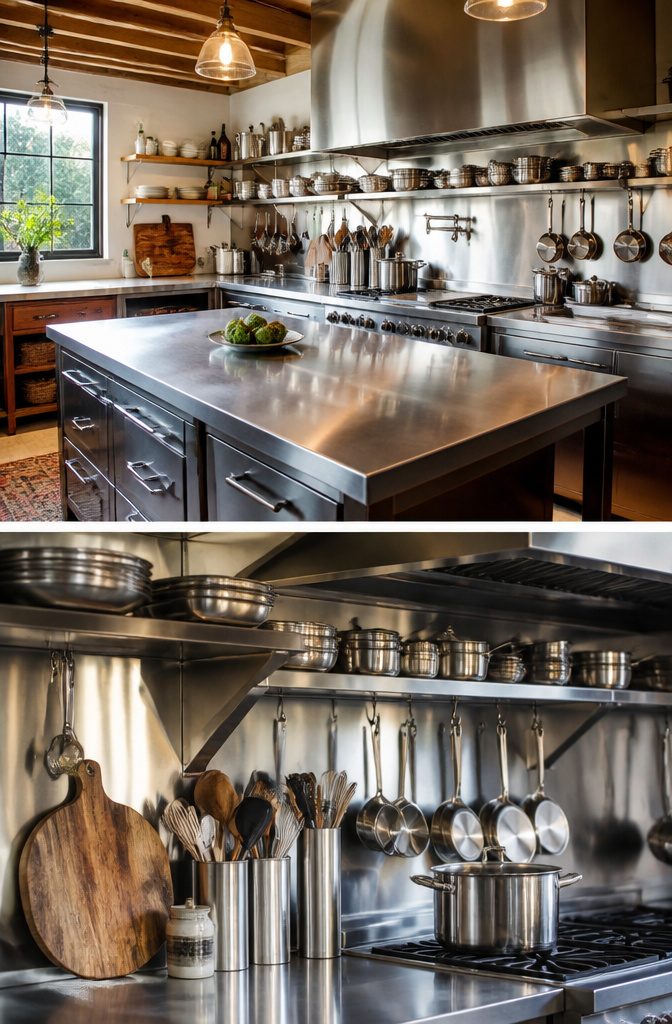
Stainless steel surfaces define the visual identity of a professional kitchen because nothing else survives the combination of acidic spills, high heat, and nightly degreasing without warping or harboring bacteria.
The material is not maintenance-free; dings and scratches collect quickly enough that a home cook should budget for periodic refinishing or learn to live with a working patina.
Where the look matters more than the abuse, engineered stone such as Dekton or Caesarstone resists stains from wine or juice and stays cool to the touch, though it sacrifices the heat tolerance that makes steel forgiving when a hot pan lands off-target.
Open shelving replaces closed cabinetry in commercial spaces because a cook moving at speed cannot afford to open three doors to find the right sheet pan.
The same logic applies at home on a smaller scale: shelving eliminates the damp, dark cavities where residue collects and where most residential users forget half their inventory.
A home adaptation might run steel or wood brackets along a single wall behind the range, keeping daily-use pans and tools visible and reachable without committing to the full hygienic specification of a licensed kitchen.
The color palette is narrower than most homeowners expect. Beyond the standard steel, black stainless steel offers one departure, and manufacturers such as BlueStar extend the range to custom colors only on their cooking products, not the surrounding architecture.
The restraint itself becomes the aesthetic: the kitchen reads as a workspace first, which is exactly the statement most home installations are after.

Custom Serving Hatch: Enhance your Space with this versatile Serving Hatch, designed to fit various door opening dimensions (width x height). Crafted for durability and ease of use, it’s an ideal solution for Restaurants, Cafés, or Home Kitchens. Enjoy the convenience of a customized size tailored to your needs, offering functionality and style.
【85° FOLDING SLIDING FOR EFFORTLESS OPERATION】Push-pull folding design allows adjusting to any angle up to 85°. Smooth sliding tracks ensure one-person easy opening/closing, efficient for food serving or item passing.
【85° FOLDING SLIDING FOR EFFORTLESS OPERATION】Push-pull folding design allows adjusting to any angle up to 85°. Smooth sliding tracks ensure one-person easy opening/closing, efficient for food serving or item passing.
Frequently Asked Questions
What is a commercial kitchen?
A commercial kitchen is a professional-grade space built for high-volume food production, outfitted with industrial-grade stoves, ovens, and refrigeration units that can run continuously through peak service.
Most commercial kitchens fall between 500 and 1,375 square feet, with the industry average near 1,000 square feet. Unlike a home kitchen, the layout centers on output volume, speed, and strict health authority standards rather than comfort for a small household.
What are the types of commercial kitchens?
The four main types are restaurant kitchens, hotel kitchens, catering kitchens, and cloud kitchens.
Restaurant kitchens move food in a straight line from raw intake to the pass. Hotel kitchens layer on volume and hour flexibility for multiple outlets.
Catering kitchens prioritize holding equipment and transport logistics over plate-to-table immediacy. Cloud kitchens strip away dining rooms entirely to optimize prep and packaging for delivery-only operations.
How do I design a commercial kitchen?
Start with aisle width of at least 3 feet, preferably 5 feet, then anchor the room into three zones: preparation closest to cold storage, cooking in the center, and cleaning downstream with dish storage directly above it.
For single-focus work, use an assembly line layout that moves dishes straight through. For split menus like baking plus savory, a zoning layout clusters equipment by task to cut down on cross-room travel.
What are the 5 types of commercial kitchen layouts?
Commercial contractors also reference open kitchens and galley kitchens as compact options for smaller spaces like apartments.
How much would it cost to set up a commercial kitchen?
The cost gap between residential and commercial installations extends beyond equipment to include structural space and utility upgrades: walk-in coolers, integrated grease traps, commercial dishwashing stations, upgraded electrical circuits, and natural gas or propane lines sized for continuous load.
Infrastructure sized for 150 percent of current draw costs more upfront but avoids a full renovation mid-growth.
What is the difference between a commercial kitchen and a home kitchen?
A commercial kitchen inherits equipment and infrastructure standards that residential wiring, gas lines, and flooring were never sized for.
Industrial-grade stoves pull more current than standard 240-volt circuits allow; commercial ventilation must exhaust grease-laden air at rates residential hoods cannot match.
Floors that survive daily service are sealed concrete or quarry tile, not vinyl or hardwood. The layout shifts from multipurpose and compact to zoned prep, cooking, storage, and dishwashing mapped for throughput and regulatory compliance.