
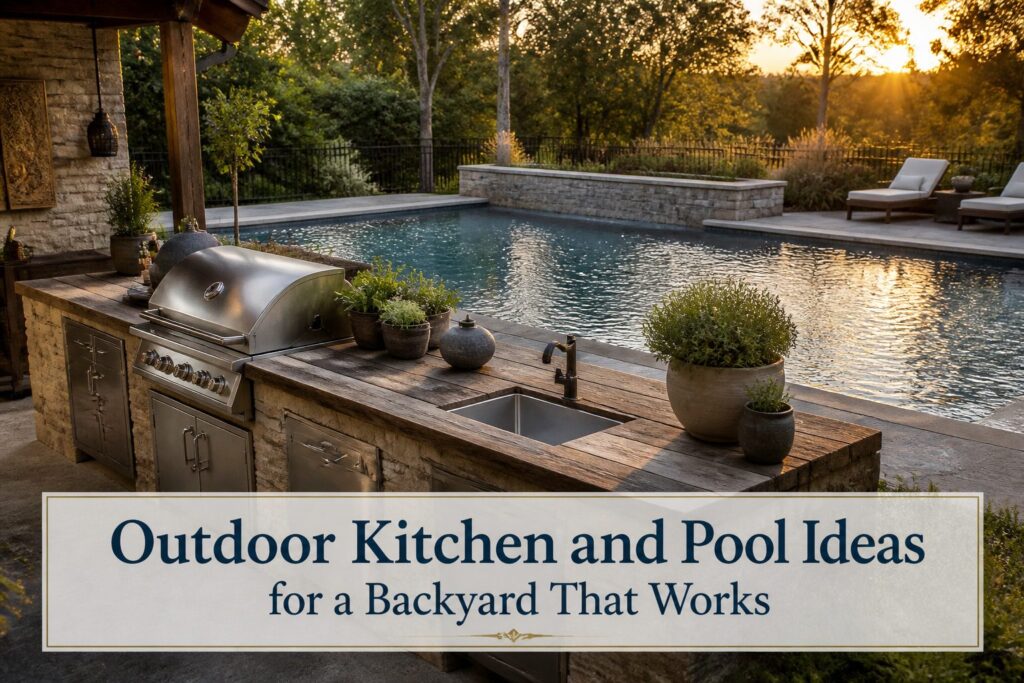
The right backyard layout depends on how much of your budget goes to the kitchen versus the pool, and whether anyone actually cooks while people swim.
Most builds run $50,000 to $150,000 or more, and the kitchen alone adds $10,000 to $15,000 on top of the water. I set the grill island with its back to the prevailing breeze so smoke carries away from swimmers, not across them.
1. The Grill Setup That Works
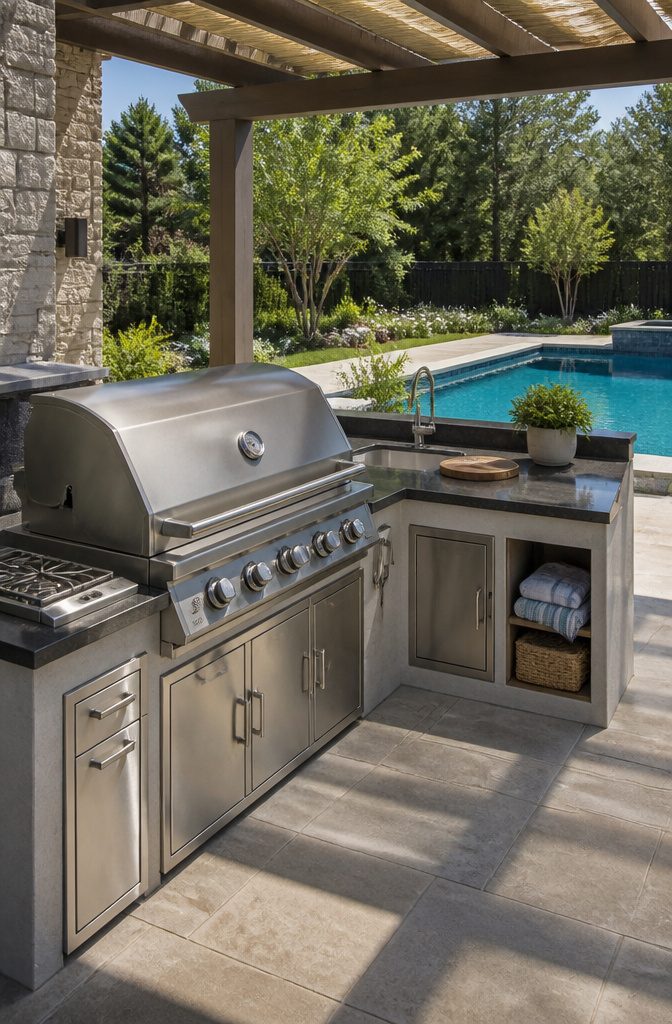
Custom built-in BBQ islands anchor an outdoor kitchen and pool setup better than any freestanding cart, mostly because they give appliances permanent, weather-hardened homes.
A typical island integrates the grill with side burners, refrigeration, and storage cabinetry rated for extreme conditions, all in one continuous structure.
That integration matters for flow. The island’sprep bench sits adjacent to the cooking surface, which leads naturally to a serving zone and then to drinks.
No one crosses the yard with wet feet to reach a fridge, and the cook stays inside the same triangle that indoor kitchens rely on.
Placement relative to the pool deserves more thought than most people give it. The prevailing breeze in your yard should carry grill smoke away from swimmers and loungers, not across them.
I set islands angled toward the pool so the cook keeps sightlines on kids in the water while working, with the grillback toward the breeze.
The L-shaped configuration handles this well: one arm holds the grill and prep, the other a bar with towel storage in a weatherproof cupboard close to the pool’s edge.
The back of the island faces upwind, and that single decision does more for guest comfort than any vent hood.
2. Why I Buy Stainless Steel
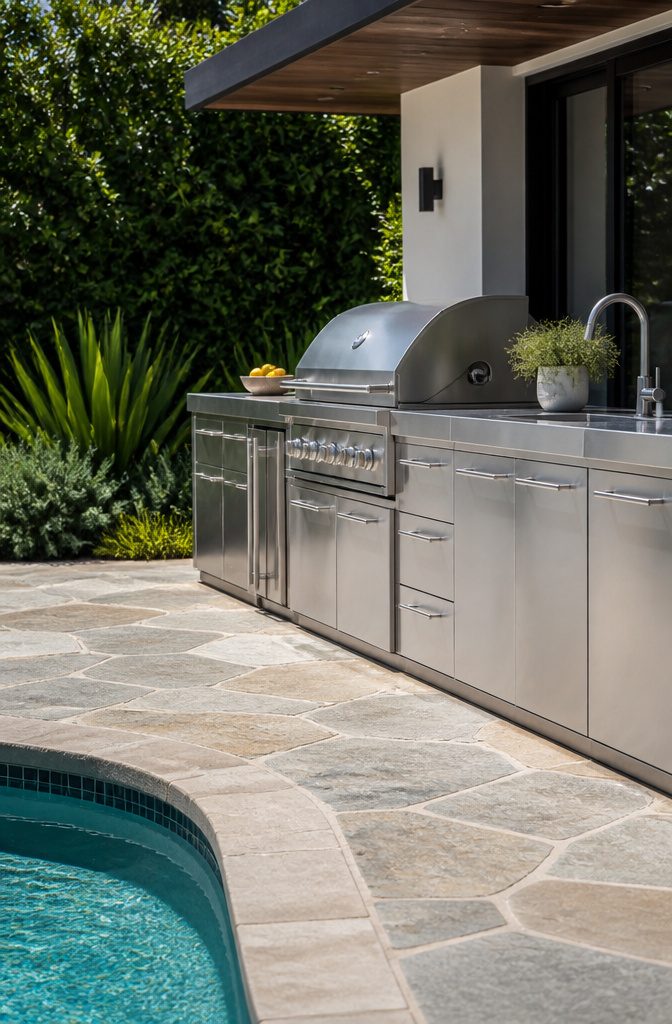
304-grade stainless steel holds up where powder-coated steel eventually surrenders.
Pool chemicals and saltwater vapor chew through lesser finishes in two or three seasons, sending rust streaking down cabinet faces whether the kitchen sits ten feet from the water or fifty.
The Brown Jordan TECNO and ELEMENTS lines solve this with integrated powder-coated handles that never expose bare metal, but the cabinet bodies underneath are still steel at the core.
I would rather start with the material itself than with a coating. Bare stainless brightens a space, bounces light around a pergola-covered cook station, and pairs with granite without fighting it.
The maintenance is honest work, a wipe-down after heavy use, rather than the creeping dread of checking for bubbling paint at the seams each spring.
Powder coat scratches; stainless steel dents, and I will take a dent that still sheds water over a scratch that invites rust.
Budget allocations run tight in a $500–800 annual project, but this is not where I would look to save thirty percent. The alternative is replacement, and countertop alignment never works the second time.
3. A Fridge Worth Plugging In
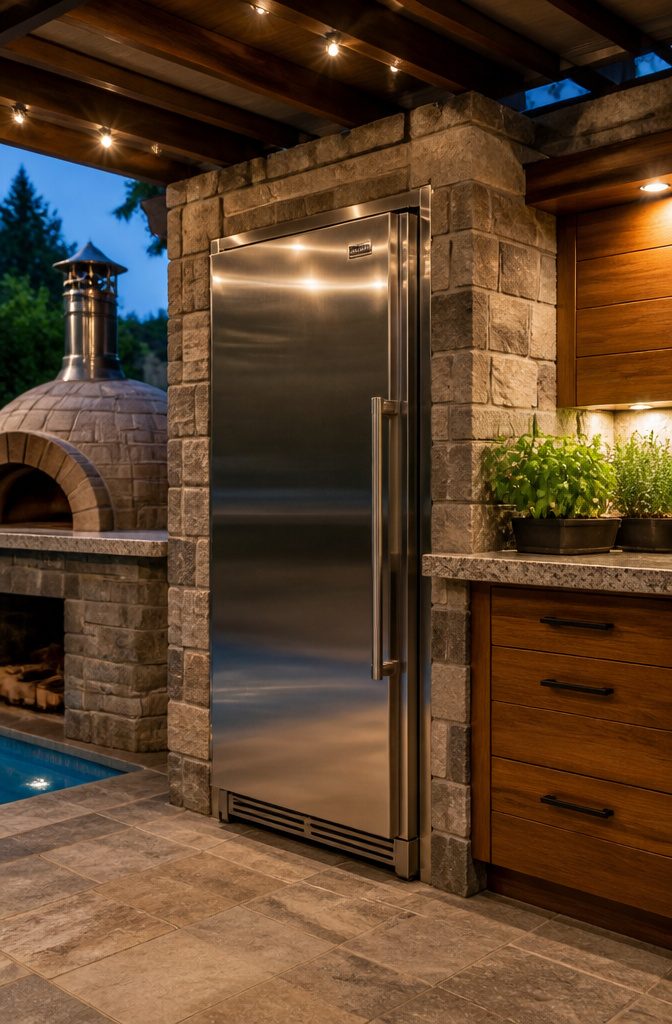
An outdoor refrigerator belongs closer to your prep area than to your pool edge.
Small units settle naturally beside the cutting board and mixing space, where you reach for berries, herbs, or a cold drink mid-recipe without breaking stride. The larger under-counter models hold more, but I find myself walking to them less often.
Placement between your grill and the nearest countertop changes how the kitchen gets used more than any appliance choice.
You also want the unit shaded under a pergola, gazebo, or three-season structure. Direct sun works the compressor harder, and the point of building outside is to enjoy a summer day, not to stand in a sunbeam waiting for ice.
I skip ice makers entirely.
A refrigerator with a small freezer compartment handles my weekend, and hauling ice from inside takes less effort than maintaining a second dedicated machine. Your calculus may differ if you host poolside often.
4. Pizza Ovens for the Few Times That Matter
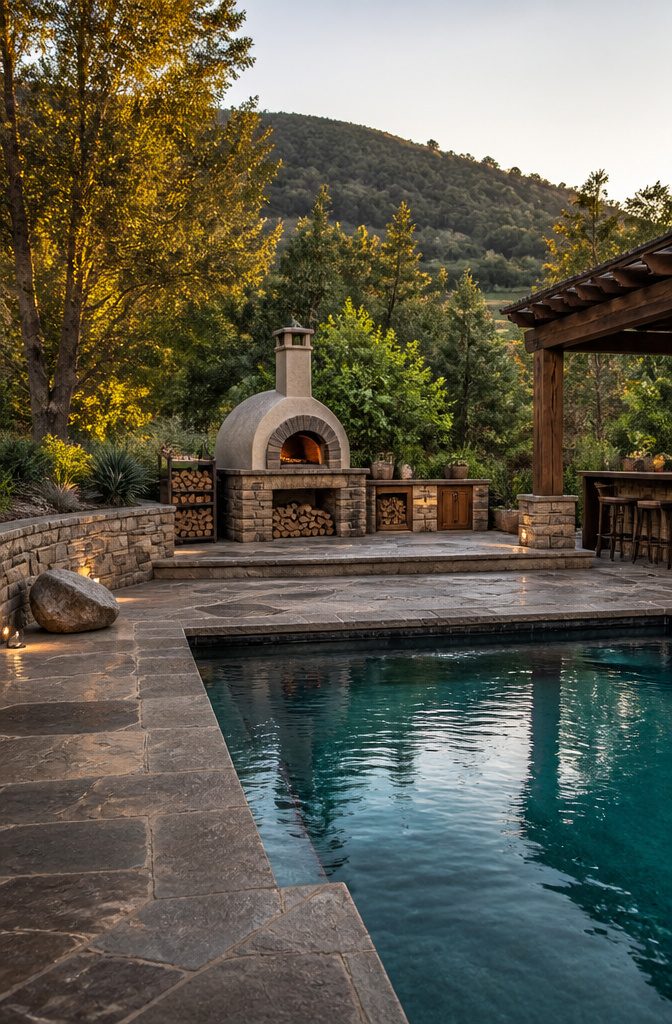
A pizza oven heats to 600°F and charrs a Neapolitan pie in ninety seconds, which sounds like the kind of magic that justifies its real estate.
I have watched guests gather around the dome the way they do around a campfire, waiting for their turn at the peel. That novelty is genuine and it lasts about three gatherings before the host starts ordering pizza instead.
Most outdoor kitchen plans give the oven too much weight. It anchors the layout, demands its own fuel line or wood stockpile, and sits cold eleven months of the year while the grill beside it runs twice weekly.
Sources put the full investment for an outdoor kitchen and pool area at $50,000 to $150,000 or more, and a built-in oven eats a measurable slice of that without adding proportionate use.
The honest accounting is simple: if you host monthly and at least two of those gatherings involve cooking together, the oven earns its keep.
If your outdoor cooking is burgers and grilled chicken on weeknights with a pool party twice a summer, the money buys more joy as better seating, sound, or lighting that operates every evening.
A smoker at least runs unattended; the pizza oven needs attendance and skill every single time.
I would rather borrow a friend’s oven once, confirm the romance, then decide.
5. The L Shape That Saves Steps
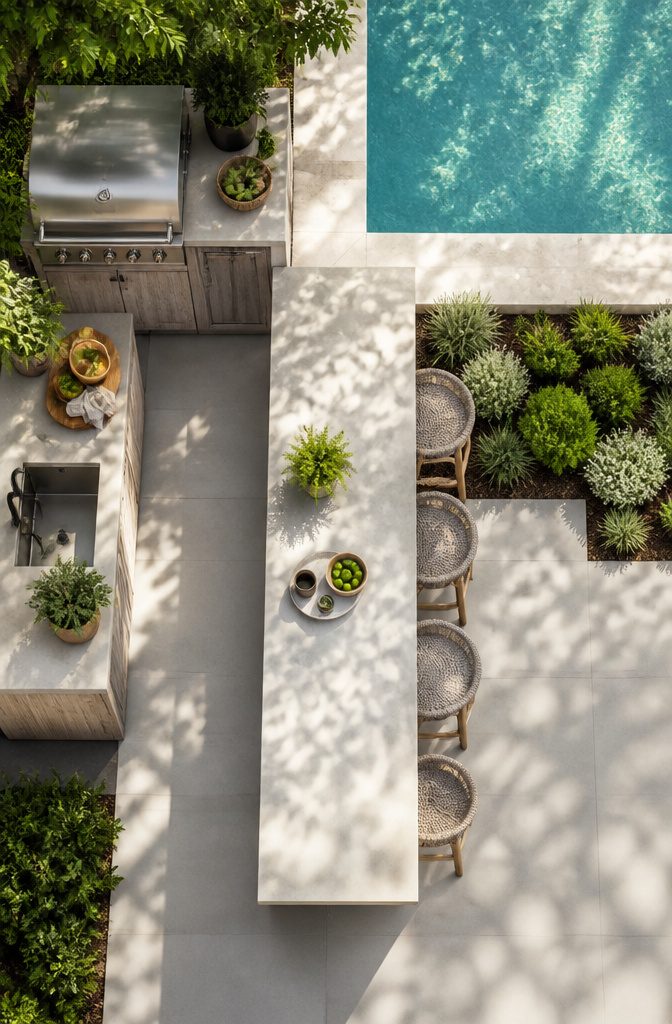
An L-shaped outdoor kitchen turns the corner for one reason that matters more than the extra counter space.
The cook faces the pool and the guests at the same time. No shouting over a shoulder, no walking back and forth to check on people.
The short leg of the L naturally fills with bar seating. Guests climb out, grab a drink, and stay in the conversation while someone else finishes the burgers.
That same corner creates a work triangle between sink, grill, and prep surface that a straight run cannot match. Straight runs leave more open space between kitchen and pool, which sounds good until you realize everyone congregates behind you anyway.
I think the L wins for most backyards because socializing and cooking are not separate activities here; they are the same one.
The corner itself is what you give up, and it can turn into dead storage unless you plan the cabinet layout carefully.
A lazy Susan or a drop-in cooler at the inside angle solves this, and the cost is small compared with building a larger kitchen just to get the same sightline.
Keep the dining table slightly away, past the bar-stool zone, so swimmers have somewhere dry to eat and the cook does not lose the open face that makes this layout worth building.
6. Cover That Actually Covers
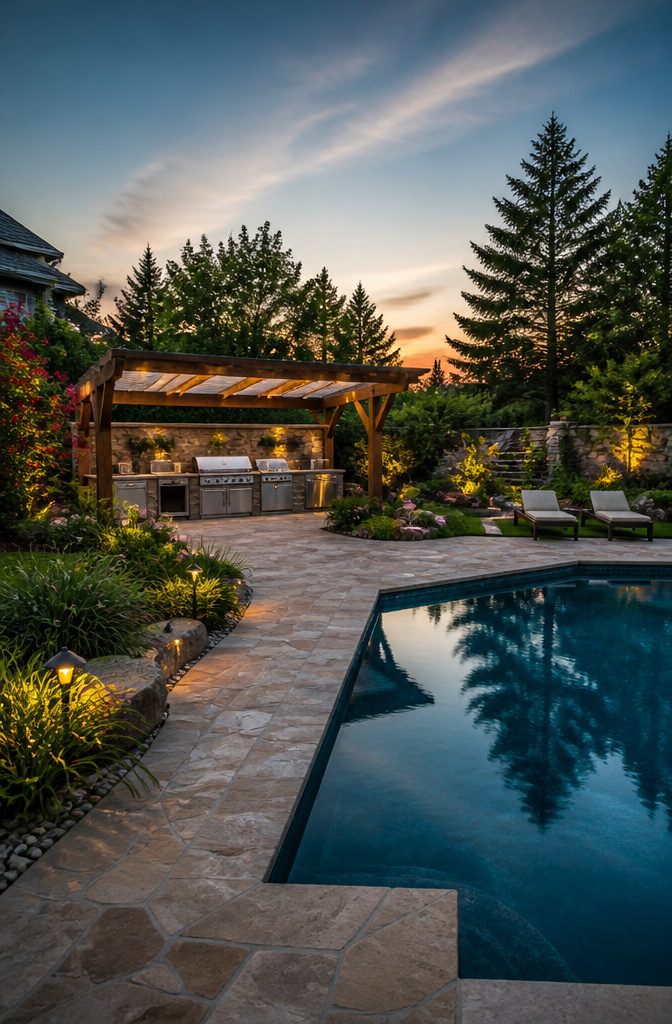
A pergola with an adjustable canopy buys more hours outside than any other single upgrade. During a typical afternoon storm, I keep cooking while everyone else is rushing inside to watch the grill through a window.
That same roof blocks peak summer sun when it makes stainless surfaces too hot to touch, and it turns a winter evening in places like Boca Raton from surprisingly cool into perfectly comfortable.
The open sides matter as much as the top. A kitchen pavilion with a covered cooking area and open views toward the pool keeps the cook part of the party instead of exiled to the far corner of the yard.
Adjustable canopies or open roof structures shelter without boxing the space in; the finish feels planned, not like a tarp thrown up after the fact.
Overhead cover also protects the investment below. Professional-grade appliances and custom cabinetry that claim to withstand extreme weather still last longer when rain and direct sun are not hitting them every single day.
A ceiling gives the option to add a fan or task lighting later, which extends usable hours even further.
I would take the partial roof over the full enclosure every time.
Full walls cut breezes, block sightlines, and turn an outdoor kitchen into an indoor kitchen that happens to have a longer commute. The point of cooking outside is staying outside.
7. Infinity Pools Look Better Than They Swim
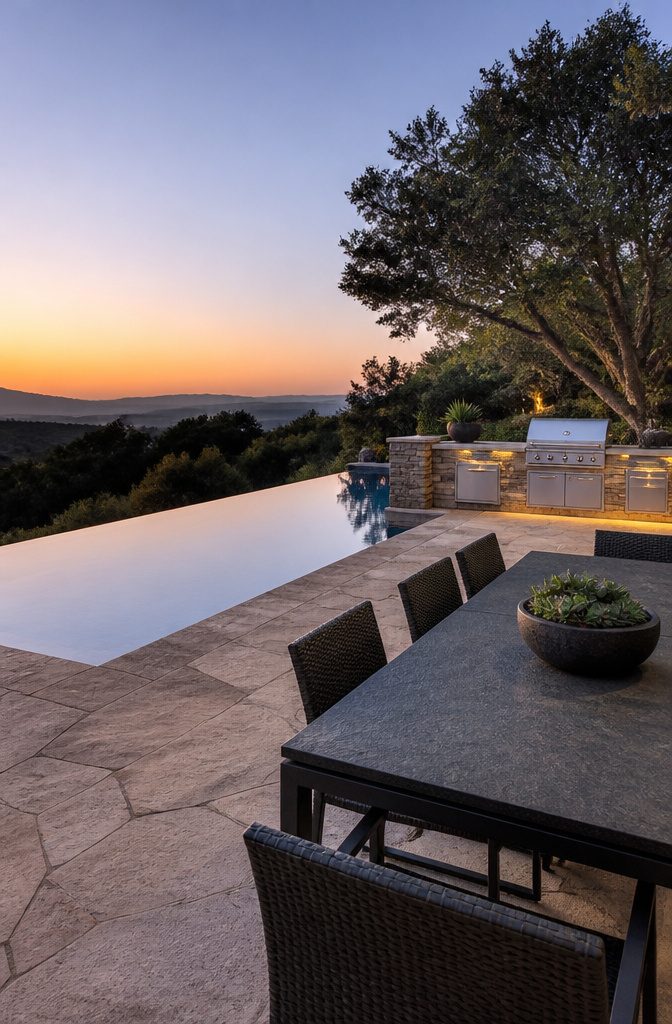
An infinity edge looks best when the grade behind it drops away hard enough to hide the catch basin entirely, giving you water that seems to run into nothing.
The view from the house changes everything; a flat yard behind the wall just looks like a pool with its coping missing.
I have watched People spend $80,000 to $150,000 and up for the excavation, structural wall, and extra circulation gear this takes, and the money buys the illusion, not the swim. The water feels the same.
You still push off the same acrylic or plaster. What shifts is what you see while floating, and whether that justifies the premium comes down to the lot you own.
Tighter budgets get a cleaner result from a standard gunite perimeter with the cash directed toward shade over the outdoor kitchen and pool hang.
8. Decking That Survives Bare Feet
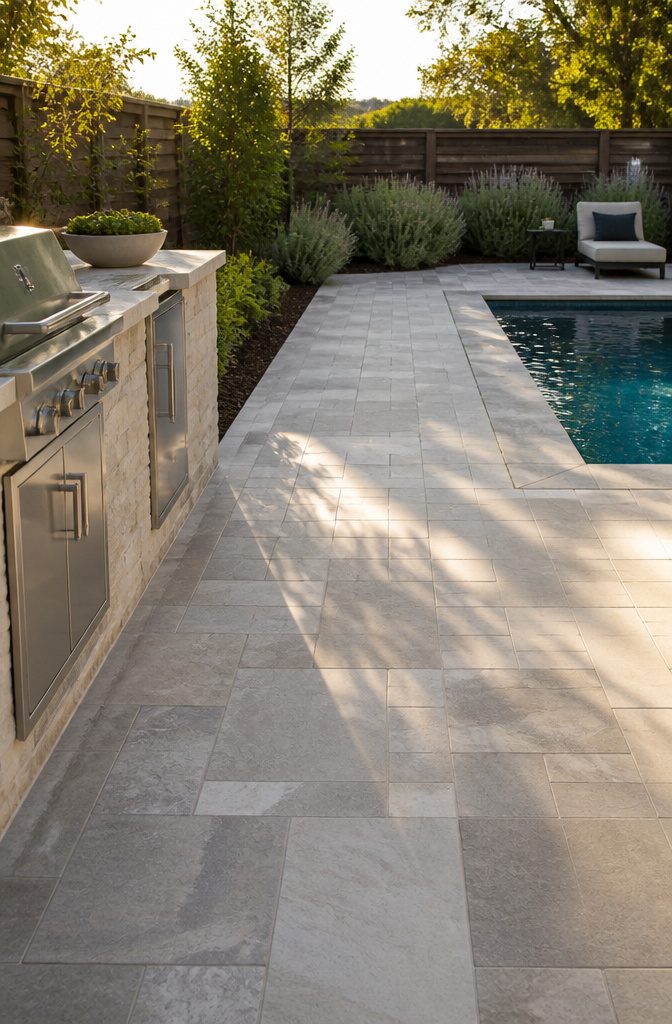
Concrete pavers with a thermal-mass threshold under 120°F at 95° ambient walk the line I look for around a pool. They store enough heat to stay warm after sunset but not so much that midday footwork becomes a sprint.
Light gray tones in a 12-24 inch format keep the visual temperature cooler than dark stone and reduce the hard-edge striping that chops small yards into smaller-feeling parcels.
The surface texture matters more than the color. Brushed or sandblasted finishes give bare feet purchase when the deck is slick from splashing; honed or polished surfaces look refined but send someone to the ER by August.
I run the same paver from the kitchen threshold to the pool coping, maybe shifting to a larger format near the grill to catch grease drips and define the zone without switching materials.
One surface across the whole plane reads as one room.
Wood composite decking nearby, if I use it at all, needs a PVC cap layer rated for full sun.
Uncapped boards soften and hold water where people drip out of the pool; the grain opens up and the bare-foot promise expires in year three.
The gap between composite and stone, I keep generous. Thermal expansion on a 90-degree day will push those boards against anything rigid.
The visual system clicks when the deck color sits between the kitchen cabinets and the pool interior.
Too light and the water looks dirty; too dark and the cooking area feels like an apparatus dropped into a hole. I sample pavers wet, dry, and at 4 p.m. before I order.
9. Fire Pits I Skip or I Don’t
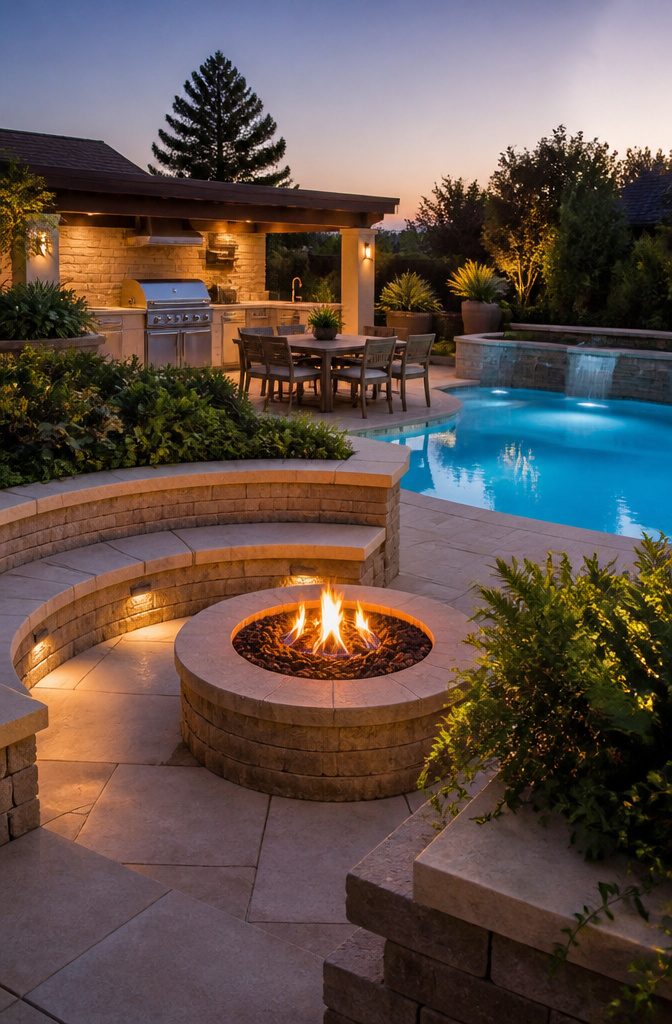
A fire pit can earn its place in a backyard that already holds a pool and an outdoor kitchen, but only when warmth is the thing you actually reach for after dinner.
Most evenings in Fort Wayne run cool by September, and a built-in stone model or a portable fire bowl extends the season well past when the water is comfortable.
The honest limit is the safety distance. Local code and plain sense both demand clearance from structures and from the pool edge, ten feet minimum from combustible walls, which in a typical suburban lot shrinks the remaining usable ground sharply.
Where space is already split between a grill station and a swimming lane, a fire pit competes rather than complements. I skip them entirely in lots under 8,000 square feet.
In larger properties, or where the kitchen sits on one side of the house and the pool on the other, a linear fire pit between the two creates a deliberate path and a third gathering point without crowding either function.
Stone seating walls around it double as wood storage if you size the cavity right. The atmosphere is real, but so is the lost square footage of grass the kids would have used at dusk.
10. Plants That Pull Their Weight
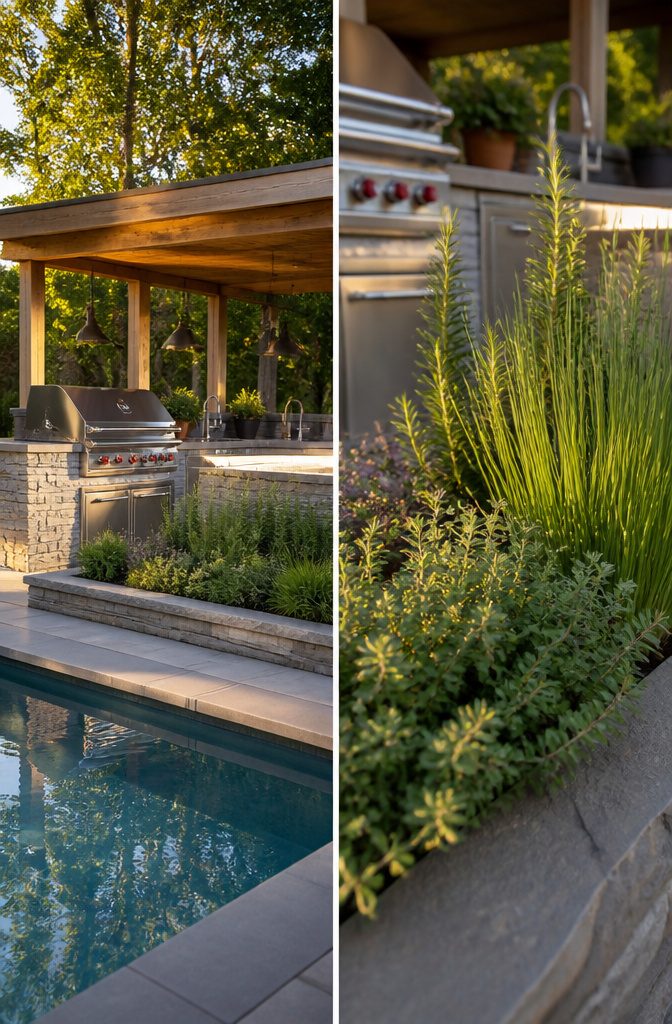
Integrated garden beds along the back edge of my outdoor kitchen and pool area do more than soften the hardscape.
Thyme creeps between stone joints and survives Indiana winters without fuss. I use it weekly; rosemary nearby I mostly touch for looks, since the variety that tolerates our zone lacks the resin punch of Mediterranean stock.
Chives and sorrel earn their keep from April to first frost, returning on their own where basil demands fresh planting each May.
Mints spread aggressively, so I corral them in a raised trough where runoff from the outdoor sink keeps roots damp.
Oregano and sage sit in the driest, sunniest corner, the one spot where pool splash never reaches. Parsley I skip outdoors entirely; it bolts too fast in summer humidity and I prefer the windowsill crop for kitchen use.
What you get back visually comes from structure, not flower.
A clipped bay in a pot frames the grill station year-round. Most of the color I get from plants I actually cook with.
What Weather Here Changes
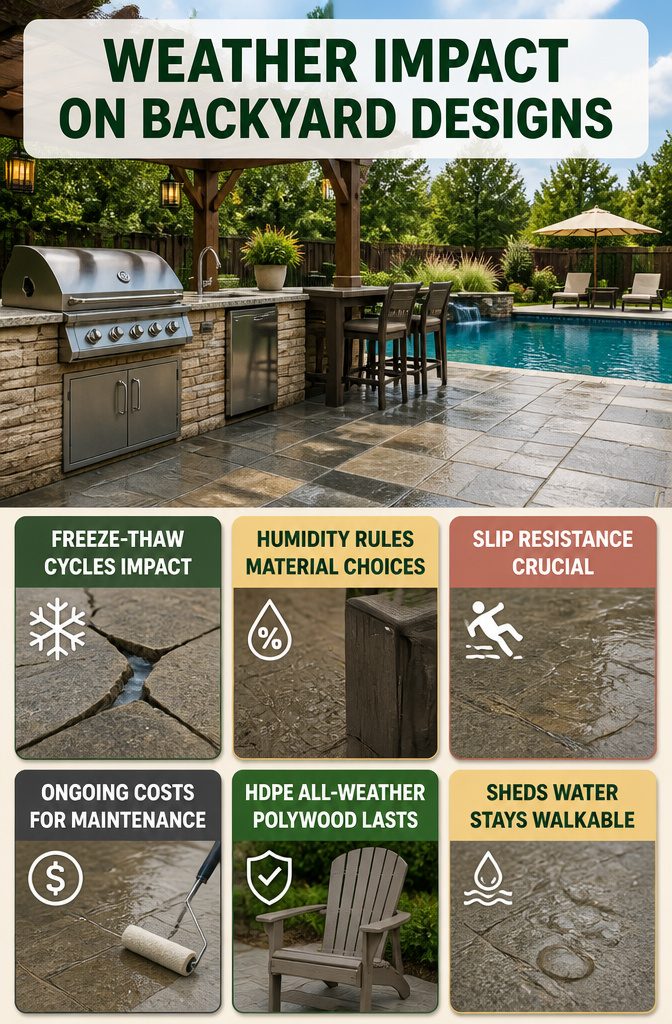
Fort Wayne sits far enough north that freeze-thaw cycles become the deciding factor on most hardscape choices. Water seeps into stone tile or imitation stone, expands when winter hits, and the surface spalls or cracks by spring.
A patio cover helps with the sudden summer downpours, but the floor still gets wet enough that slip resistance matters more than pattern: glossy geometric designs in two or three contrasting shades look sharp dry and treacherous after a June storm.
Humidity here runs thick through July and August, which narrows the material shortlist for any wood accents or metal framing around the pool. Ordinary lumber cups and warps; untreated steel hardware surfaces with rust before Labor Day.
The product lines that hold up through both problems, like the all-weather POLYWOOD lumber substitutes, are built from HDPE that does not absorb moisture and is made to take temperature extremes without the cracking or peeling that ruins cheaper outdoor furniture in this climate.
If you are choosing flooring for the outdoor kitchen, the modern stone look is achievable, but the maintenance cost is ongoing resealing against freeze damage.
My preference runs toward materials that shed water rather than fight it, and surfaces that stay walkable when a covered area still leaves you damp.
Materials I Pay For Once
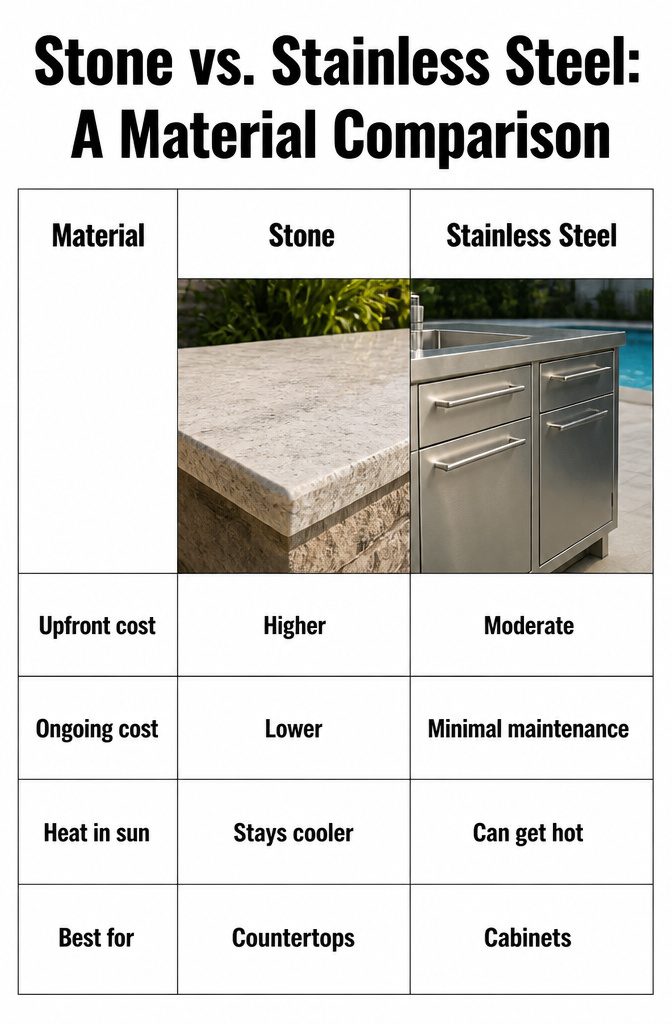
Stone and stainless steel are the two materials I trust for cabinets and countertops in an outdoor kitchen and pool setup, but they earn that trust differently.
Powder-coated stainless steel handles humidity, saltwater, and pool chemicals without the rust risk that bare steel pulls invite after a season or two of splash and spray.
Stone, especially lighter colors, stays cooler under direct sun than dark countertops or unshaded stainless surfaces that can turn painful to the touch in peak summer hours.
| Material | Upfront cost | Ongoing cost | Heat in sun | Best for |
|---|---|---|---|---|
| Stone | Higher | Lower | Stays cooler | Countertops, built-in surrounds |
| Stainless steel with powder coat | Moderate | Minimal maintenance | Can get hot | Cabinets, handles, frames |
Stone costs more to install and resists cutting or modifying later, which is the trade-off I accept for a surface that does not need refinishing.
Stainless steel with a proper powder coat finish skips the annual sanding and sealing cycle but shows dents and scratches more readily than stone. Stone wins on decades-long lifespan; powder-coated stainless wins on near-zero upkeep.
The $10,000 Question
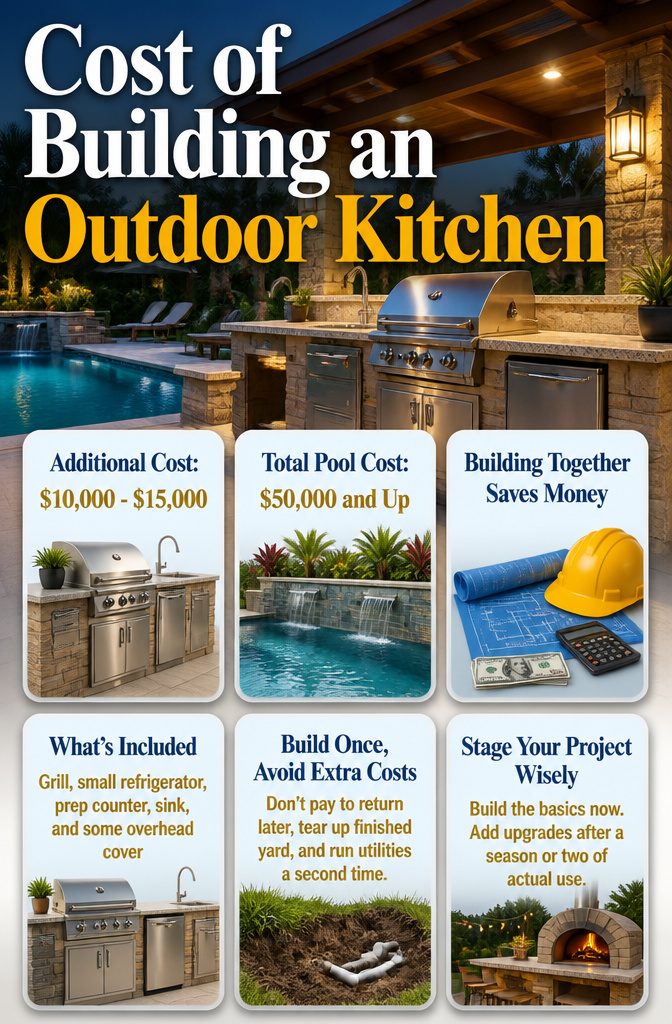
An additional $10,000 to $15,000 sits on top of basic pool construction, which is the practical starting point for a no-frills outdoor kitchen.
That figure covers a grill, small refrigerator, prep counter, sink, and some overhead cover, enough to cook and serve without running back inside.
Pool costs layer on separately and start far higher.
In warmer markets like Parkland or West Palm Beach, the combined build often runs $50,000 to $150,000 or more depending on size and materials. The kitchen is not the part that blows the budget, but it is also not a rounding error.
An estimate of an additional $10,000 to $15,000 is needed to construct the kitchen.
What this means is simple: if you are already digging for a pool, adding the kitchen during that single construction window saves money on labor and coordination.
Bundling the work avoids paying a crew to return later, tear up finished yard, and run utilities a second time.
Stage the project if the total feels steep.
Build the pool and the basic kitchen now. Add the pizza oven, better lighting, or bar seating after a season or two of actual use, once you know where you actually stand and what you actually miss.
Layout Moves That Keep Smoke Out of Faces
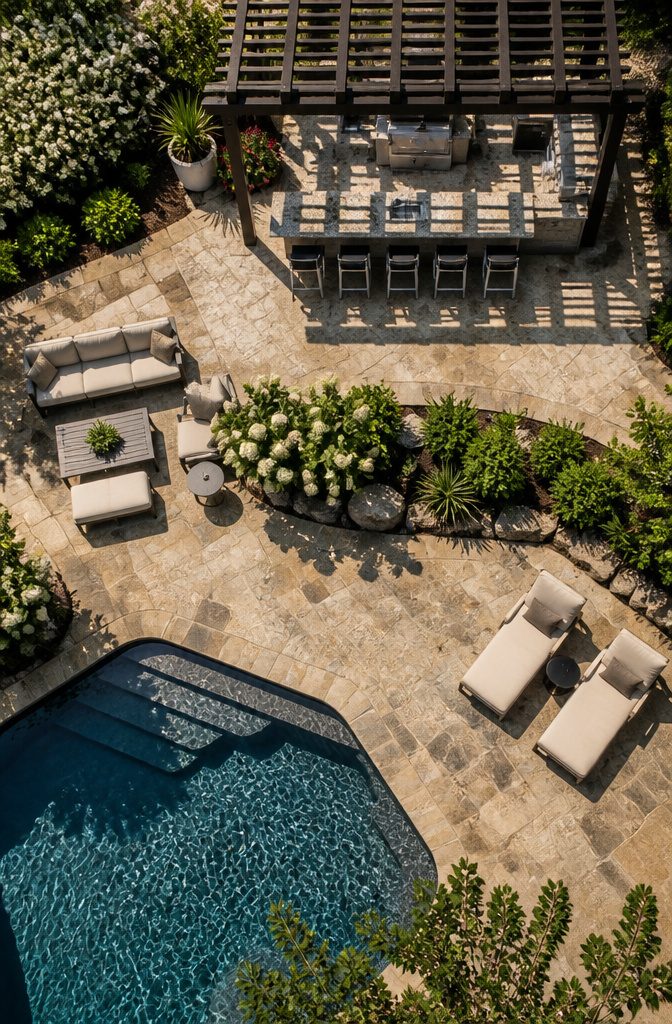
Prevailing wind direction should settle where the grill ends up.
In most backyards across the Midwest, that means positioning the cooking zone downwind of seating and at least 10–15 feet from the pool’s edge, close enough to keep the cook in the conversation but far enough to stop smoke from drifting across swimmers.
The mistake I see repeated is tucking the grill into a corner where breeues push everything toward the patio table.
A pergola helps redirect some of it, yet the real fix is starting with a morning wind check before anything gets built.
Bar seating along the kitchen counter keeps guests facing the cook, not turned away toward the pool.
That small detail matters more than the appliance package: people linger where they can pass a drink or comment on what is hitting the grates.
The cook stays part of the gathering instead of staging meals to carry across the yard.
Separate lounge seating still belongs in the plan, just farther back where dry guests can relax without leaving the scene entirely.
Zones that share sightlines but split activity, that is the layout that lets a backyard actually work when more than four people show up.
Frequently Asked Questions
What are the best materials for an outdoor kitchen?
304-grade stainless steel and stone are the two materials that hold up best in an outdoor kitchen and pool setup.
Stainless steel resists rust from pool chemicals and saltwater vapor, while stone stays cooler under direct sun and lasts decades without refinishing.
Powder-coated stainless steel handles humidity without the annual sanding and sealing cycle, though it can get hot to the touch in peak summer hours.
How much does it cost to build an outdoor kitchen?
A basic outdoor kitchen runs $10,000 to $15,000 on top of pool construction, covering a grill, small refrigerator, prep counter, sink, and some overhead cover.
Combined pool and kitchen builds typically range from $50,000 to $150,000 or more depending on size, materials, and market. Adding the kitchen during the same construction window as the pool saves money on labor and utility runs.
What features should I include in an outdoor kitchen?
The essentials are a built-in grill, prep counter, sink, small refrigerator, and some form of overhead cover like a pergola or gazebo.
A bar with seating along the counter keeps guests facing the cook, and an L-shaped layout lets the cook watch the pool while working.
Skip dedicated ice makers unless you host constantly; a refrigerator with a small freezer compartment handles most weekends.
What are some good pool options for a small backyard?
A standard gunite perimeter pool typically serves a small lot better than an infinity edge, which needs a significant grade drop behind it to look right and costs $80,000 to $150,000 or more.
In tight spaces, skip the fire pit entirely; it demands ten feet of clearance from combustible walls and competes for square footage with the kitchen and swimming lane.
Direct savings toward shade structures over the outdoor kitchen and pool hang instead.
What type of countertop is best for an outdoor kitchen?
Stone, especially lighter colors, wins for countertops because it stays cooler under direct sun than dark surfaces or unshaded stainless that can turn painful to the touch.
Stone costs more upfront and resists modification later, but it sheds water well and avoids the annual resealing cycle that freeze-thaw climates demand of other materials.
The maintenance tradeoff is honest: higher initial cost, lower ongoing cost, and a surface that lasts decades.
Is there a difference between a summer kitchen and an outdoor kitchen?
The terms are often used interchangeably, though ‘summer kitchen’ historically referred to a separate outbuilding for cooking in hot weather, while modern outdoor kitchens are integrated hardscape with permanent utilities and weather-rated appliances.
An outdoor kitchen and pool setup today typically means built-in grills, refrigeration, and storage tied to the home’s systems and designed for year-round use under cover.
The contemporary version is less about escaping heat and more about social cooking with sightlines to swimmers and guests.





